
Overlapping IP addresses and CIDR blocks are a common problem in hybrid and multicloud environments. The issue occurs when two networks use the same IP range, which makes standard routing unreliable and can lead to outages. This guide explains why overlapping IPs happen, what breaks when they do, and the most common deployment patterns used to resolve IP overlap across cloud, on-prem, and partner/customer networks.
On This Page
Understanding the overlapping IP problem
Common scenarios that cause overlapping CIDRs
What breaks when overlap exists
How to fix overlapping IPs using IP mapping (NAT)
Deployment patterns: intra-cloud, inter-cloud, partner/customer networks
Subnet overlap vs full CIDR overlap
Benefits of using Aviatrix for overlapping IPs
FAQs
Understanding the Overlapping IP Problem
Overlapping IPs occur when identical IP ranges are assigned to different networks or applications. When those networks need to communicate, routers cannot correctly determine where to send traffic because the destination IP exists in more than one place.
This becomes more likely as organizations:
grow across multiple cloud providers
add environments quickly without centralized IP governance
connect to customers, partners, and vendors
merge networks during acquisitions
Common Scenarios Leading To Overlapping IP Addresses
Below are some common scenarios and use cases that Aviatrix solution architects have seen repeatedly with customers:
Independent network design in cloud-based services or applications needing to connect to external customer networks.
Mergers and acquisitions combining networks with independently planned IP ranges.
Connectivity to third-party vendors and partners, where each network was designed without coordination.
Within an organization, especially when different business units independently design their cloud VPCs or on-premises networks, potentially leading to overlaps even across AWS VPCs and Azure VNETs.
What Happens on the Network when Overlapping IPs are Present?
Let’s consider a setup where Application 1 resides in Network 1. In this illustration, we’ll assume it’s an AWS VPC (see image below) . This application needs to reach application 2 in network 2 (for example a customer site). Both networks (1 and 2) have the same IP range: 10.0.0.1-to-10.0.0.255. So, when Application 1 sends a message to Application 2, the router of Network 1 will loop the packet back into Network 1.
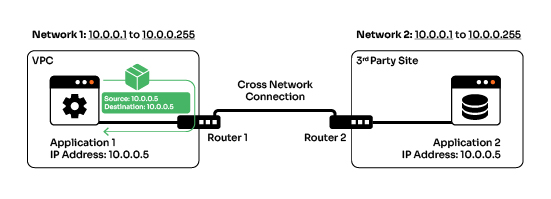
Connecting these networks together creates faulty traffic flows or even worse, unpredictable traffic flow. This scenario should be avoided at all costs. Accidental overlapping IP (CIDR) connections have resulted in major network outages.
How to Fix Overlapping IP Problems
The most common way to solve overlap without renumbering networks is to use IP mapping (often implemented with NAT). The idea is to translate one side of the connection into a virtual, non-overlapping range so routing becomes unambiguous.
Aviatrix solves overlapping IP connectivity by mapping conflicting IP ranges to virtual IP ranges, allowing networks to communicate without changing application configurations. For example, one network’s overlapping range can be mapped to a virtual range like 192.168.0.0/24.
How the mapping works
When Application 1 sends a packet to Application 2, the Aviatrix Gateway maps the source and destination IPs into the virtual range.
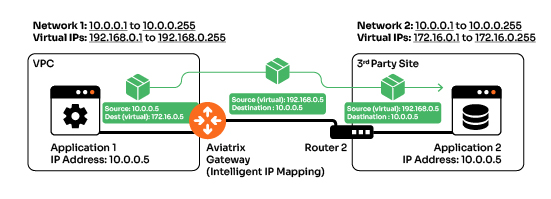
2. When Application 2 responds, the gateway performs the reverse mapping so return traffic routes correctly.
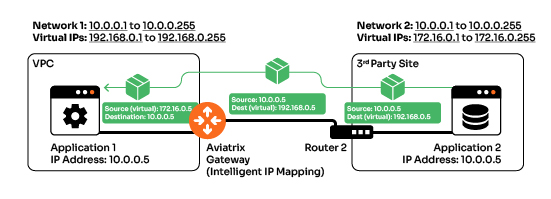
The result is connectivity that remains transparent to applications, without renumbering networks.
Common Deployment Patterns to Address Overlapping IPs
Resolving Intra-cloud IP Address Overlaps
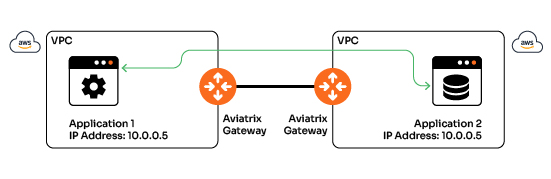
Sometimes overlap happens inside the same cloud provider, such as between two AWS VPCs or between multiple environments created by different teams. In this case, organizations can peer networks while using Aviatrix Gateways to map the overlapping ranges so traffic can route cleanly.
Common use case: internal cloud environments built independently (multiple VPCs/VNETs) that later need connectivity.
Fixing Inter-cloud IP Address Overlaps
Some organizations have overlapping IP issues across cloud providers (for example, an AWS VPC and an Azure VNET using the same CIDR). The same mapping approach can be used across clouds, enabling communication without renumbering either side.
Common use case: multicloud expansion where each cloud environment was designed independently.
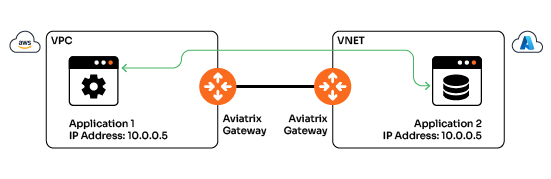
Handling IP Overlaps in Partner and Customer Networks
SaaS providers and enterprises often need to connect to many third-party networks (customer sites, partner clouds, third-party VPCs/VNETs/VCNs). These networks have a high likelihood of overlap. Even when overlap is not present, many organizations prefer to mask internal IP ranges from external parties.
In these deployments:
IP mapping prevents overlap-related routing failures
masking supports better security posture
the IPsec connection can be terminated on a non-Aviatrix endpoint (for example, a cloud-native VPN gateway), depending on the architecture
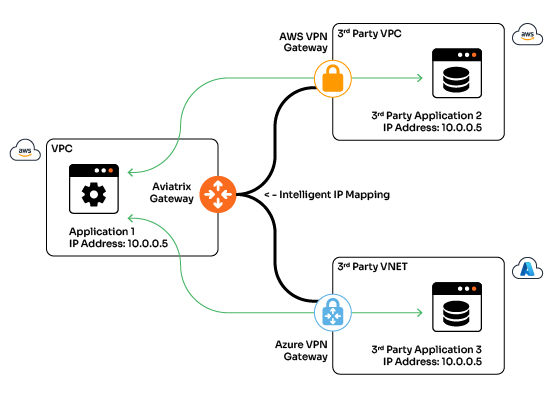
Handling IP Address and Subnet Overlaps
In many real environments, overlap is not always the entire CIDR block. It is often a subnet overlap—where one or more subnets collide across networks.
Subnet overlap causes the same routing failures as full overlap. The Aviatrix Gateway’s mapping approach resolves subnet overlap using the same principles: translate conflicting ranges into a virtual, non-overlapping space so routing remains deterministic.
Key Benefits of Using Aviatrix for Overlapping IPs
The advantages of the above-mentioned solutions are:
It is a simple configuration in the Aviatrix Controller.
There is no need to change configurations in the applications. It is transparent to the applications and the application owners.
It is transparent to the third-party router (Router 2). All the intelligence is built into the Aviatrix Gateways running in your public cloud (AWS/Azure/GCP/OCI etc.)
Built-in high availability (HA) across Availability Zones and Regions.
Using this solution, enterprises can handle overlapping IP issues that come up internally within the organization or with external connectivity requirements involving customers and partners.
Conclusion
Overlapping IPs are a predictable outcome of hybrid and multicloud growth. The key is to solve the problem in a way that is operationally practical—without renumbering networks or modifying applications. IP mapping using Aviatrix Gateways enables deterministic routing, reduces outage risk, and makes it easier to onboard partners and customers at scale.
Learn more about how to handle IP overlap and exhaustion:
Explore how the Aviatrix Kubernetes Firewall helps tackle IP overlap and exhaustion in Kubernetes deployments.
Discover how Aviatrix can empower app modernization.

