
TL;DR
Chokepoint Security is the approach of routing all traffic through centralized inspection points (firewalls, gateways, proxies) to detect and block threats.
It was designed for the Perimeter Era (1995–2010), on-premises environments with predictable network topologies.
In cloud environments, Chokepoint Security creates performance bottlenecks, can't scale with dynamic workloads, and fails completely at preventing lateral movement.
The Containment Era replaces Chokepoint Security with Communication Governance, eliminating unauthorized paths rather than inspecting traffic at bottlenecks.
Aviatrix's Containment Platform is explicitly designed to replace, not extend, Chokepoint Security.
What Is Chokepoint Security?
Most cloud security architectures were built on the same foundational idea: route traffic through a centralized inspection point, catch anything suspicious, and let everything else through. That's Chokepoint Security. For on-premises networks with predictable traffic patterns, it worked reasonably well. In cloud environments with thousands of dynamic workloads, constant east-west communication between services, and lateral movement that can happen at machine speed, it has structural problems that no amount of tuning can fix. Chokepoint Security routes all network traffic through centralized inspection points to detect and block threats in flight. The Containment Era replaces it with Communication Governance, eliminating unauthorized communication paths rather than inspecting traffic after connections are already permitted.
How Chokepoint Security Works
Chokepoint Security concentrates security enforcement at strategic network points such as central firewalls, cloud gateways, and inspection proxies through which all traffic is routed. Security tools at these chokepoints inspect traffic in flight, comparing it against signatures, behavioral models, and policy rules. Traffic that matches known-bad patterns is blocked; everything else passes.
This model made sense in the Perimeter Era. On-premises networks had clear, predictable topologies. Traffic volumes were manageable. The number of services communicating was finite. Routing everything through a central inspection point was operationally feasible and provided meaningful security coverage.
Why Chokepoint Security Fails in Cloud Environments
Cloud environments are fundamentally incompatible with the Chokepoint Security model, for three structural reasons:
1. Scale and Dynamism
Cloud environments have thousands of dynamic workloads: containers that launch and terminate in seconds, microservices that autoscale, ephemeral compute instances. Every new workload or communication path requires firewall rule updates at the chokepoint. The operational overhead is unmanageable, and stale rules create security gaps that accumulate over time.
2. Performance Bottlenecks
Cloud architectures are built for high-throughput east-west communication: microservices calling other microservices, services reading shared data, event-driven pipelines. Routing all of this through centralized inspection creates latency, reduces throughput, and can create bottlenecks that impact application performance. Security teams face constant pressure to loosen rules to maintain application performance.
3. East-West Blind Spot
Chokepoint Security was designed for north-south traffic: flows between external users and internal services. East-west traffic (workload to workload within the cloud environment) often bypasses perimeter controls entirely or is subject only to coarse-grained security group rules. This is precisely the traffic that lateral movement exploits. Chokepoints don't see it; they can't stop it.
The difference between Chokepoint Security and Communication Governance is architectural.
Chokepoint Security: Allow all traffic by default, route it through inspection, block known-bad. Result: east-west lateral movement is uninspected and uncontrolled. Attackers who get inside move freely.
Communication Governance: Block all communication by default, explicitly permit only what's needed, enforce
at the workload level. Result: attackers who get inside find no open paths to move laterally.
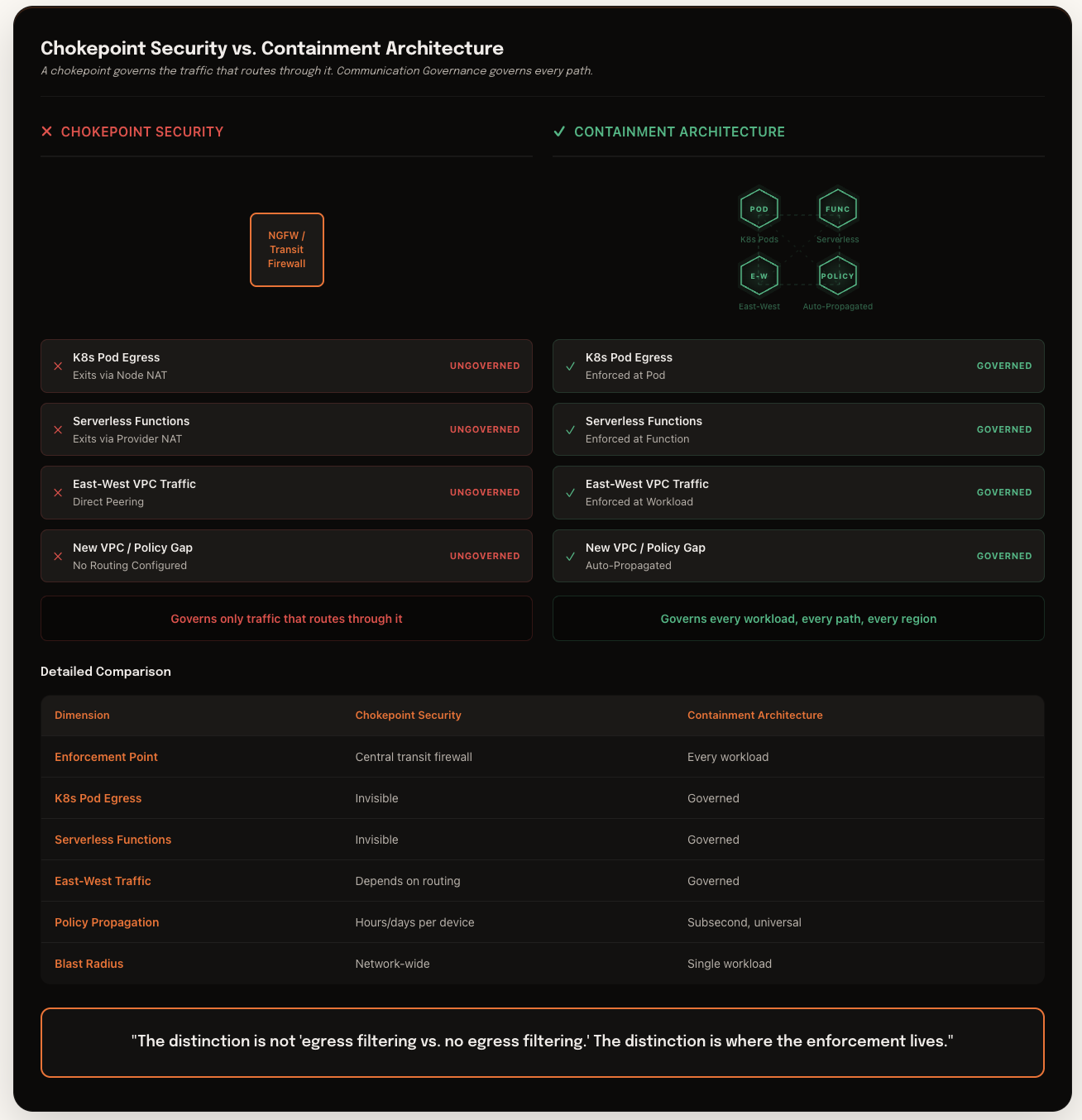
Chokepoint Security vs. Communication Governance
This is why the Containment Era treats Chokepoint Security as the approach being replaced, not extended. Adding more sophisticated inspection tools to a chokepoint architecture doesn't solve the fundamental problem: open east-west paths that give attackers unlimited lateral movement capability.
Transitioning Away from Chokepoint Security
Moving from Chokepoint Security to Communication Governance is not a one-day migration. Most organizations operate both models in parallel during transition.
The practical path: start by running a Workload Attack Path Assessment (WAPA) to understand your current east-west exposure. Identify the highest-risk paths, those with the largest blast radius impact. Begin applying Communication Governance policies to the most critical workload clusters first. Expand coverage systematically until the dependency on chokepoints for east-west security is eliminated.
Aviatrix's Containment Platform supports phased migration: you can implement Communication Governance alongside existing perimeter controls and expand coverage incrementally.
Frequently Asked Questions
Q: What is Chokepoint Security?
Chokepoint Security is the security approach that routes all network traffic through centralized inspection points, firewalls, proxies, and gateways to detect and block threats. It allows all traffic by default, inspects it in flight, and blocks known-bad patterns. It was the dominant security model of the Perimeter Era and early Detection Era, but fails to scale in cloud environments.
Q: Why does Chokepoint Security fail in cloud environments?
Three structural reasons:
Scale: cloud environments have thousands of dynamic workloads requiring constant firewall rule updates, which create operational chaos and stale rules.
Performance: routing all east-west traffic through central inspection creates bottlenecks.
East-west blind spot, chokepoints can't control workload-to-workload communication, which is exactly where lateral movement happens.
Q: What replaces Chokepoint Security in the Containment Era?
Communication Governance replaces Chokepoint Security. Instead of routing traffic to inspection points, Communication Governance defines which workloads are permitted to communicate and enforces those policies at the workload level. Unauthorized connections are never established, so there's nothing to inspect or detect.
Q: Does Aviatrix use Chokepoint Security?
No. Aviatrix's Containment Platform is explicitly designed to replace Chokepoint Security with Communication Governance. Aviatrix distributes enforcement to the workload level using identity-based policies through SmartGroups, not IP-based rules managed at centralized gateways.
Q: Can organizations transition from Chokepoint Security gradually?
Yes. Most organizations run both models in parallel during migration. The practical approach is to start with a Workload Attack Path Assessment (WAPA) to understand current east-west exposure, then apply Communication Governance policies to the highest-risk workload clusters first, expanding coverage systematically until chokepoints are no longer needed for east-west security.

