
AWS networking services are the AWS tools used to design connectivity, routing, traffic distribution, and private access for workloads running in Amazon VPC—plus hybrid and internet-facing architectures. This guide organizes the most-used AWS networking services by category (VPC foundations, transit, hybrid connectivity, edge delivery, DNS/traffic management, and private connectivity) so you can quickly choose the right service for your design.
What Does AWS Networking Services Offer?
AWS Networking Services (at a glance)
AWS networking services fall into six common categories:
VPC foundations: Subnets, route tables, security groups, NACLs, Internet/NAT gateways
Transit: Transit Gateway (TGW), AWS Cloud WAN
Hybrid connectivity: Direct Connect, Site-to-Site VPN
Edge and acceleration: CloudFront, Global Accelerator
DNS and traffic management: Route 53 (plus routing policies and health checks)
Private service access: VPC Endpoints, AWS PrivateLink
Core AWS Networking Services
AWS’s networking suite is a testament to its commitment to providing robust, scalable, and secure networking options for its diverse customer base. These services are designed to meet the dynamic needs of modern enterprises, facilitating seamless connectivity, enhanced security, and efficient data distribution across the globe.
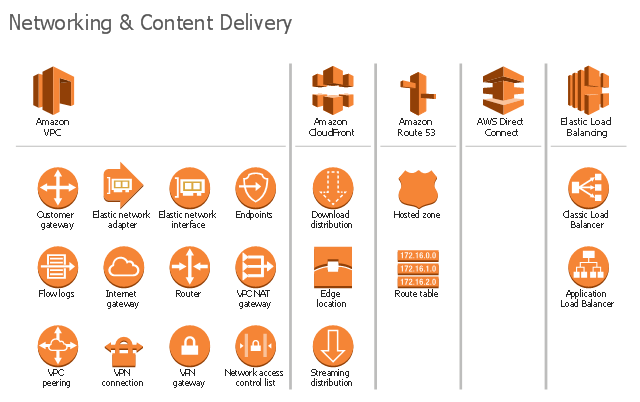
Amazon CloudFront: This Content Delivery Network (CDN) exemplifies efficiency, delivering content with high transfer speeds and low latency. Integrated with AWS’s infrastructure, CloudFront ensures secure and rapid data delivery worldwide.
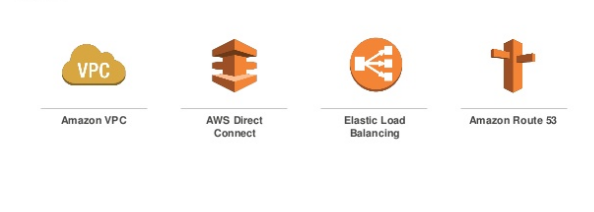
Amazon Virtual Private Cloud (VPC): Amazon VPC offers users a segregated portion of the AWS cloud, granting complete control over the network environment. This service enables precise configuration of IPs, subnets, and gateways, catering to a variety of application hosting needs.
AWS Direct Connect: By establishing a dedicated network connection from an on-premises data center to AWS, Direct Connect reduces costs and increases bandwidth throughput, enhancing the connectivity between on-premises networks and AWS’s cloud environment.
Elastic Load Balancing: This service adeptly distributes incoming network traffic across multiple targets, such as EC2 instances, ensuring application resilience and performance stability under varying load conditions.
Amazon Route 53: A scalable DNS web service, Route 53 efficiently translates domain names into IP addresses, facilitating reliable and cost-effective end-user application routing.
Transit networking: Transit Gateway vs Cloud WAN
AWS Transit Gateway (TGW) connects multiple VPCs and on-prem networks through a hub-and-spoke transit model, simplifying routing compared to many-to-many peering.
AWS Cloud WAN provides a managed WAN layer for building global networks with centralized policy and segmentation across regions and connectivity attachments.
Quick rule of thumb:
Choose TGW for straightforward hub-and-spoke transit.
Consider Cloud WAN when you want centralized global policy/segmentation at large scale.
Private connectivity: VPC Endpoints and AWS PrivateLink
Use VPC endpoints to privately access supported AWS services without traversing the public internet.
Use AWS PrivateLink for private access to services across VPCs (including third-party and internal services) while reducing public exposure.
Hybrid connectivity: Direct Connect and Site-to-Site VPN”
Use Site-to-Site VPN for encrypted connectivity over the internet and quick setup.
Use Direct Connect for dedicated connectivity when throughput consistency and latency predictability matter. Many organizations use DX as primary + VPN as backup.
Traffic visibility: Flow Logs and Traffic Mirroring
Use VPC Flow Logs for visibility into accepted/rejected traffic metadata at the VPC/subnet/ENI level.
Use VPC Traffic Mirroring when you need packet-level inspection workflows (e.g., NIDS tooling).
Quick chooser: which AWS networking service should I use?
Need DNS + traffic steering/failover → Route 53
Need global content delivery → CloudFront
Need private network foundation → VPC
Need connect many VPCs + on-prem → Transit Gateway / Cloud WAN
Need dedicated hybrid connectivity → Direct Connect
Need private access to AWS/partner services → VPC Endpoints / PrivateLink
Need distribute app traffic → Elastic Load Balancing

