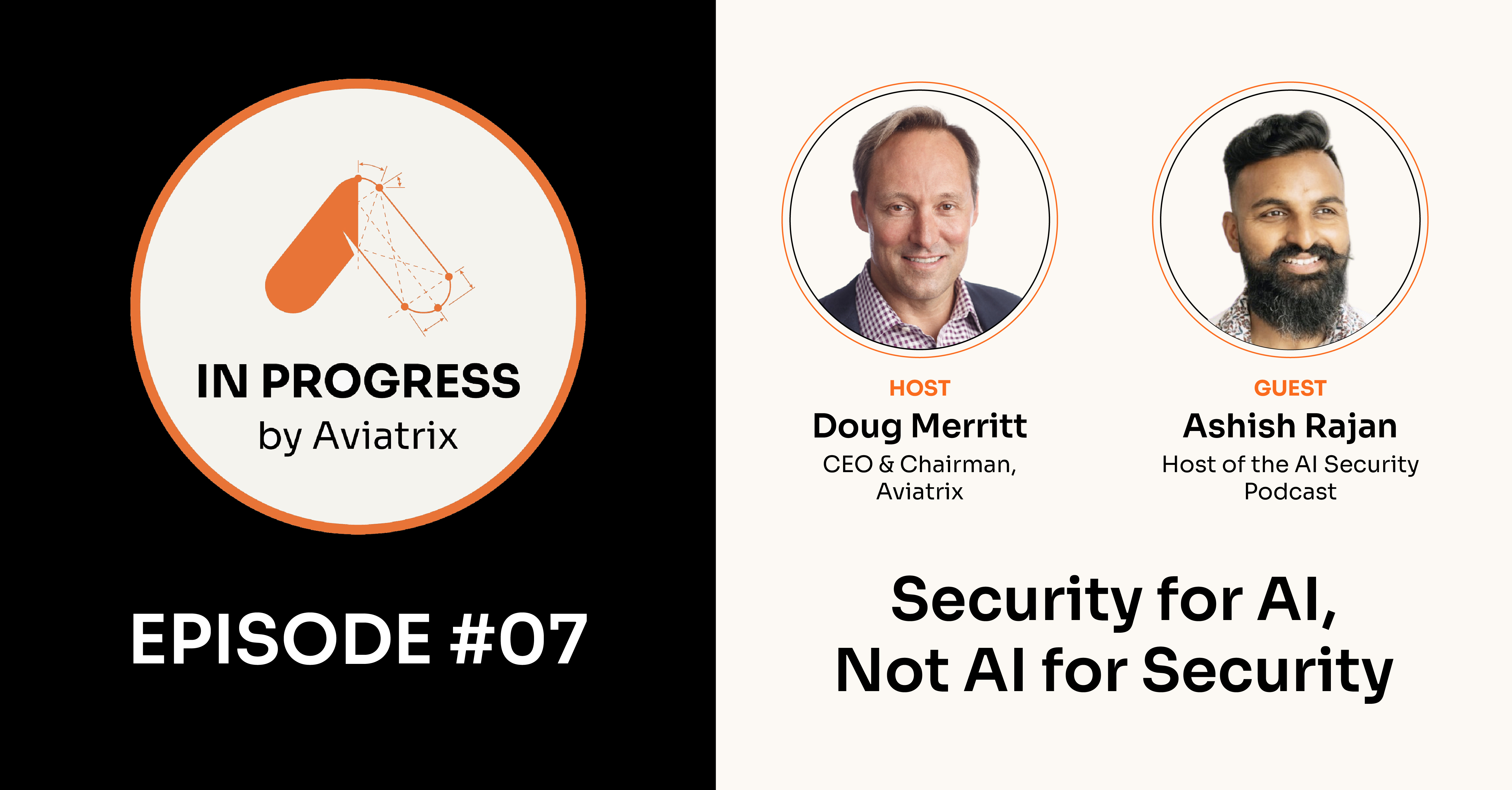

Aviatrix CEO Doug Merritt appeared on Ashish Rajan’s “AI Security” podcast to talk about Doug’s career, how enterprises are approaching blast radius and reachability, and how AI has changed the physics of cyber.
The Story of Doug’s Career
Doug summarized his career, starting with his role as a “coarse hacking programmer” at Accenture to serving as the CEO of Splunk, briefly retiring, then stepping back into the game with Aviatrix.
Doug explained the trajectory of cybersecurity over the last few decades. “The bulk of cyber was really dominated for decades on prevention, and prevention originally was physical theft,” he said. Cybersecurity measures in those days included badge readers on data centers. When enterprises began moving to the cloud, they effectively plugged the internet into those secure data centers.
“The internet was not built for security,” he explained. “It was built for communications and collaboration.”
When Doug arrived at Splunk, Splunk was still focused on prevention. After widespread cloud adoption, it shifted to detection. Now, with Aviatrix, Doug has adapted and now advocates for a better solution than detection.
Prevention is still critical, but with LLMs becoming so effective at writing code and finding vulnerabilities in code, the old system of publishing vulnerabilities and patching them as fast as possible is no longer enough.
Last year, CrowdStrike found that 80% of intrusions were malware-free and used valid credentials, meaning that no detection signal could go off. That escalation in attacker techniques means that data breaches like the March 2026 LiteLLM supply chain attack are possible.
The only fallback left is containment: limiting your blast radius. Containment at the network level means preventing systems that don’t need to talk to each other from communicating, segmenting your network, and monitoring egress.
Network Security in an Agent World
Ashish asked Doug how network security would work in a world of autonomous AI agents, considering worrying case studies like the Open AI/Hugging Face incident.
Doug argued that the 7-layer OSI model still lives, it’s just been abstracted; containment and blast radius still apply. He compared AI agents to bots from the Matrix that can go through walls. These agents are tireless, persistent, and can find a way out of an environment that seems completely hardened. He explained that networks need a sandbox that is firm on all walls, in every dimension.
Doug broke down the OpenAI/Hugging Face incident and how it unfolded with a zero day, and unknown egress channel, agent collaboration, and lateral movement. Doug argued that two things would have stopped the incident: “that whole thing would be a non-reported event if we had effective egress and effective lateral movement controls in the world.”
“What I have found with our independent, non-Aviatrix-biased interrogation of hundreds of customers' landscapes, is I can say with confidence, no company is covered fully,” he said. “Most companies are wide open on egress, reachability from the public internet, at more than 50% of their cloud workloads. It is a horrifying landscape.”
You Own Your Own Workloads
Doug called out a reality that many enterprise security teams don’t realize: in the shared responsibility model, cloud service providers do not secure your entire cloud estate. That responsibility is yours.
“The messaging that the clouds came out with is, ‘We are way safer than the data centers that you could build,’” Doug said. “'Other than one or two other companies in the world, we've got way, way more security than you guys do.’ And that is true . . . That's not the problem. The problem is you own all your own workloads.”
Ashish agreed. “Ultimately at the end of the day, if there's a data breach, the cloud is not responsible because we, the customer of the cloud, own the data,” he said.
Making Egress and Segmentation Easier, Faster, and Safer
Doug described Aviatrix’s work with customers who are stuck in brownfield environments and don’t see a viable way to implement egress or segmentation. Doug assured leaders in this situation that egress is simple and easy to implement with the right tools. Segmentation takes more time because it takes planning and coordination to implement, but it is achievable.
The harder part for security leaders is the “budget cycles and metrics” – getting boardroom buy-in for these security initiatives. Aviatrix is equipping leaders to make the right case to their boards by arming them with metrics. “Right now, there are very few boards that I know of who have a reachability or blast radius metric,” Doug said. “But it is, I think, the most important metric. It's what I care about.”
Ashish pointed out that reachability and blast radius metrics are even more necessary because the window between vulnerability discovery and exploit is quite small. Worse, there may not be a patch for every vulnerability if you don’t own every piece of software in your estate.
“Do your own work on your own environment,” Doug urged security leaders. “Almost all of you have got totally flat networks in the cloud . . . I guarantee you that other than maybe one or two of you listening, you have 50-90% of your workloads with full egress exposure.”
Ashish encouraged listeners to try to answer a simple question: “Can I accurately manage, or can I accurately measure, my blast radius today?”
Ready to see Aviatrix in action?
Get a personalized live demo walkthrough or explore our latest deep-dive cloud threat research intelligence.
Gartner Strategic Roadmap for Zero Trust Security Programs 2025 Report
Download and gain actionable insights to advance your cloud security strategy.