
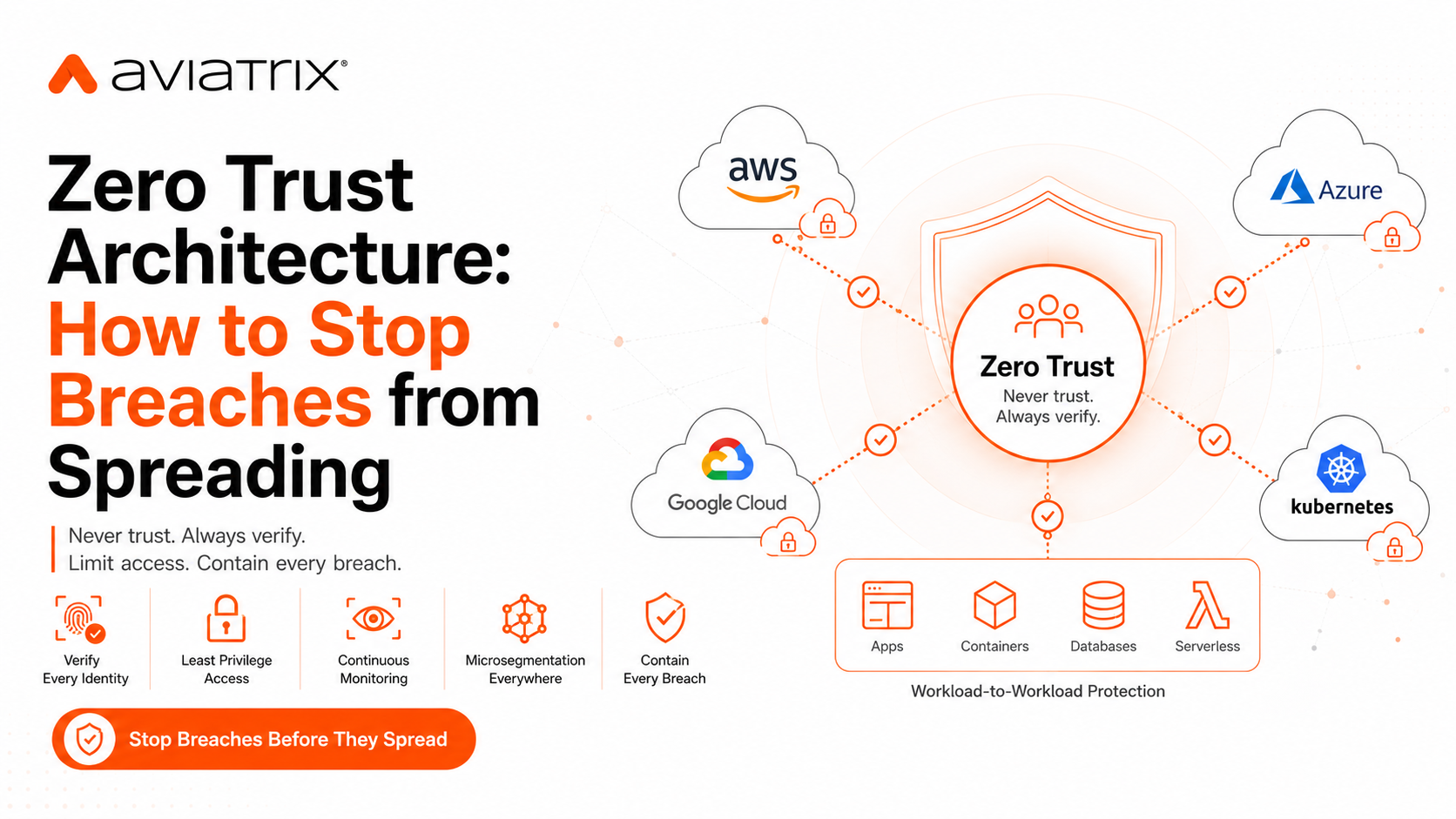
- The Zero Trust model operates on the principle of "never trust, always verify," eliminating implicit trust from the corporate network entirely.
- Least privilege access and continuous monitoring are foundational Zero Trust principles that limit what any compromised workload or user can reach.
- Traditional perimeter security fails against modern supply chain attacks, insider threats, and lateral movement inside cloud environments.
- Remote users and distributed cloud workloads get the same continuous verification and per-application access controls that protect on-premises endpoints.
- Aviatrix's Cloud Native Security Fabric delivers Zero Trust architecture at the workload-to-workload layer, where lateral movement and data exfiltration actually happen.
- Why traditional perimeter security fails against cloud adoption, remote work, supply chain attacks, and modern lateral movement techniques
- The core principles of Zero Trust architecture, including continuous verification, least-privilege access, microsegmentation, and the "assume breach" mindset
- How NIST SP 800-207 and federal Zero Trust initiatives define the framework enterprises are adopting today
- Why Zero Trust Network Access (ZTNA) is replacing VPNs for secure remote access and application-level connectivity
- The workload-to-workload enforcement gap that leaves many Zero Trust deployments exposed to lateral movement inside cloud environments
- How to implement Zero Trust incrementally, starting with high-risk workloads, east-west traffic visibility, and least-privilege controls.
- Why breach containment depends on enforcing policy at the workload layer, not just at user identities, endpoints, and network perimeters
- How Aviatrix Cloud Native Security Fabric delivers workload-level Zero Trust enforcement across AWS, Azure, Google Cloud, Kubernetes, and hybrid environments from a single policy plane.
Modern enterprises do not get breached through the front door. Attackers get inside through trusted code, stolen credentials, and compromised dependencies, then move freely across the network because nothing stops them once they are in. Zero Trust architecture was designed to close that gap.
What is Zero Trust Architecture?
Zero Trust architecture is a security framework that eliminates implicit trust from corporate networks, requiring continuous verification of every user, device, and workload before granting access. It applies least-privilege access controls and microsegmentation to limit blast radius, ensuring that when a breach occurs, it cannot spread.
Zero Trust Architecture and Why the Perimeter Security Model Broke
For decades, network security worked like a castle. Build strong walls, control the gate, and assume everything inside the network perimeter is safe. That model held when employees worked at desks in a single office and applications ran on servers inside the building.
It does not hold anymore.
Zero trust architecture starts from the opposite assumption: no user, device, or workload should be trusted by default, regardless of whether it is inside or outside the corporate network. The Zero Trust security model treats every access request as potentially hostile until it is verified. The boundary is not a perimeter fence but a policy applied continuously at the point of access, for every request, every time.
John Kindervag introduced Zero Trust principles while at Forrester Research in 2010, proposing that organizations "never trust, always verify."1 Over a decade later, the model has become the dominant security framework for enterprises managing distributed cloud environments.
What Changed: Why Zero Trust Network Access Became Necessary
Three forces collapsed the case for perimeter security:
Cloud adoption spreads workloads across AWS, Azure, and Google Cloud. There is no single perimeter to defend when applications run in multiple regions across multiple providers.
Remote work became permanent. When users connect from home networks, coffee shops, and personal devices, the corporate network boundary means nothing. Zero Trust network access solves this by verifying the user identity and device security posture before granting access, regardless of where the request originates.
Supply chain attacks bypassed perimeter controls entirely. The Cascade, a coordinated attack campaign in early 2026, exploited a trusted Python library called LiteLLM used by roughly 36% of cloud environments.2 Threat group TeamPCP pushed malicious versions to PyPI through a compromised CI/CD dependency, harvesting AWS, GCP, and Azure credentials from environments before anyone noticed. No perimeter control saw it coming because the attack arrived through signed, trusted code.
Key Components of a Zero Trust Architecture Framework
Zero Trust architecture is not a single product. It is a security strategy built from several interlocking components.
Identity and Access Management as the Foundation
Every Zero Trust model starts with identity. Before any user or workload gains access to a resource, the system must verify who or what is making the request. Identity and access management platforms handle authentication, enforce multi-factor authentication, and feed verified identity data into access decisions.
Multi-factor authentication is not optional in a Zero Trust environment. Passwords alone can be stolen without producing any anomalous signal. Requiring a second factor for every access request significantly reduces the risk of credential-based attacks.
Least Privilege Access: Give Only What Is Needed
The principle of least privilege access means granting users and workloads only the minimum level of permissions required to perform their function, and nothing more. Just enough access, nothing broader.
In practice, this means that a developer who needs read access to a database should not have write permissions. An application microservice that calls an API endpoint should not have keys to the full cloud storage environment. Strict access controls applied at this granularity reduce Blast Radius, the set of systems and data that compromised code can reach when it runs.
Continuous Monitoring and Continuous Verification
Traditional access management grants access once and trusts the session indefinitely. Zero Trust principles reject that model. Continuous monitoring means that access is not a binary gate that opens and closes once; it is an ongoing evaluation of whether the user, device, and context still meet policy requirements.
Continuous verification treats every packet and every session as a new access request. If the device security posture changes mid-session, access can be revoked immediately. If a workload begins reaching destinations outside its defined policy, enforcement kicks in without waiting for a human to review a threat detection alert.
Micro-Segmentation and Network Segments
Zero Trust architecture divides the network into granular network segments and enforces strict access controls between them. Even if an attacker gains a foothold in one segment, they cannot move laterally to another without passing through policy enforcement.
This is how Zero Trust organizations prevent lateral movement, which is how most serious breaches escalate. The attacker gets in through one compromised credential, then moves from workload to workload harvesting sensitive data. Microsegmentation cuts that path.
Device Security and Endpoint Verification
Every device connecting to enterprise resources must meet defined security standards before gaining access. This includes managed corporate devices and, increasingly, bring your own device endpoints. Device security checks include patch level, configuration compliance, and presence of required security software.
Secure remote access solutions extend these device checks to remote users, ensuring that policy enforcement does not stop at the office door.
Zero Trust Architecture and Federal Agencies: Why NIST Made It Official
Federal agencies are not ahead of enterprise in most security areas, but Zero Trust is an exception. In 2020, the National Institute of Standards and Technology published NIST SP 800-207, the formal definition of Zero Trust architecture for federal agencies.3 In 2021, the Biden administration's executive order on improving the nation's cybersecurity mandated a Zero Trust security model across federal agencies.4
NIST's definition establishes that Zero Trust architecture assumes breach by default. The traditional security assumption that the internal network is trusted goes away. Instead, every access request is verified against a defined policy, regardless of network location.
The Zero Trust enterprise framework laid out by NIST covers seven tenets, including that all data sources and computing services are treated as resources, that all communication is secured regardless of network location, that access to resources is determined by dynamic policy, and that the enterprise monitors and measures the integrity of all assets.
For federal agencies, meeting these standards is mandatory. For enterprises, the NIST framework provides the clearest published roadmap for Zero Trust implementation.
Measure Your Zero Trust Maturity
Zero Trust isn't about preventing every breach—it's about limiting what attackers can do after they get in. Take the free Zero Trust Readiness Assessment to evaluate your organization's access controls, segmentation strategy, lateral movement exposure, and breach containment capabilities. Get a personalized analysis in under 15 minutes. →
Why the Zero Trust Model Fails Without Workload-Level Enforcement
The most common failure point in Zero Trust implementation is scope. Organizations deploy strong identity and access management at the user layer and strong device security checks at the endpoint, but they leave workload-to-workload traffic inside the cloud uncontrolled.
This is where breaches spread.
When a compromised workload inside a cloud environment can reach any other workload without restriction, the attacker who controls it has broad access to the entire cloud estate. Zero Trust principles applied only to user-facing access do not cover this exposure.
The Zero Trust security model requires enforcement at every layer: user access, network access, and workload-to-workload communication inside the cloud. The trust security model cannot have gaps. One unsegmented path is all an attacker needs.
Aviatrix's Cloud Native Security Fabric closes this gap by embedding enforcement directly into the cloud fabric at the workload layer, governing what every workload can reach and what can reach it, across every cloud, every VPC, every Kubernetes cluster, and every serverless function, from a single policy plane. This is containment: the architectural enforcement of explicit communication policy at every workload, on every path, independent of whether a compromise has been detected.
Questions to ask your team:
Can your current tools verify a workload's identity if its IP changes during a rescheduling event?
Do you have inline inspection on east-west traffic between your Kubernetes pods and adjacent services?
If an AI agent in your environment made an unauthorized outbound API call right now, would you see it?
Zero Trust Network Access vs. Traditional VPN for Remote Access
For remote access, Zero Trust network access replaces the broad-access model of traditional VPNs. A VPN places the remote user inside the network once authenticated, giving them access to the same flat network that an office employee sees. The Zero Trust model grants access only to the specific application the user needs, verified at the time of each request.
This matters because attackers who compromise a VPN credential gain the same broad access as a legitimate employee. Under a Zero Trust model, compromising a single credential grants access only to what that credential is explicitly permitted to reach.
This access model also continuously verifies the session. Access can be revoked in real time if the device security posture changes, anomalous behavior is detected, or the user attempts to reach resources outside their defined permissions.
Here is a quick comparison:
Assume Breach: The Mindset That Makes Zero Trust Architecture Work
The assume breach mindset is not pessimism. It is an engineering decision with direct security consequences.
If an organization designs its security posture assuming that attackers will eventually get in, it invests in limiting what they can do once inside. Access controls, network segmentation, and least privilege access become the primary defenses, not just the perimeter firewall.
The assume breach principle shifts the primary metric from "did we prevent entry" to Blast Radius: when compromised workload code runs, how far can it reach? A Zero Trust architecture built on this principle limits the answer to a very small number of systems.
The Cascade demonstrated why this matters. Credentials harvested from compromised LiteLLM instances gave attackers keys to cloud environments. In environments with strict access controls and workload-level enforcement, those keys opened very few doors.
Privilege Access and the Risk of Over-Permissioned Workloads
Most cloud environments are over-permissioned by design. Development teams request broad access to move faster. Service accounts accumulate permissions over time. AI workloads shipped under deadline carry credentials that grant far more access than their function requires.
Privilege access creep is one of the most consistent contributors to large-scale breaches. The attacker does not need to break in when an existing service account already has the permissions they need.
Zero trust implementation that takes permission hygiene seriously audits every service account, every API credential, and every workload permission regularly. In a mature Zero Trust architecture, this process is automated: access rights are reviewed continuously, unused permissions are revoked automatically, and any deviation from defined policy triggers an immediate alert.
How to Start a Zero Trust Implementation
Zero Trust strategy does not require replacing everything at once. The most effective implementations start with the highest-risk exposure and expand from there.
A practical sequence:
Inventory every asset and every AI agent. You cannot contain what you have not catalogued.
Block known bad destinations. Threat intelligence feeds, geographic blocking, and DNS hardening reduce exposure with minimal risk to production.
Apply least privilege access to the highest-risk workloads first. Crown-jewel applications, production databases, and AI workloads handling sensitive data are the starting point.
Add continuous monitoring to east-west traffic between workloads. This is where Blast Radius lives.
Extend per-application access controls to all remote users and devices, replacing broad VPN access with verified, session-based connections.
Each step is reversible. Each step compounds the security value of the one before it.
Conclusion
Zero Trust architecture is not a product category or a marketing term. It is a security framework built on the recognition that perimeter defense fails against modern attackers who operate inside trusted networks, through trusted code, and with legitimate credentials.
The Zero Trust model that actually reduces breach impact applies continuous verification, strict access controls, and minimum-privilege enforcement at every layer: user access, network access, and workload-to-workload communication inside the cloud. Federal agencies have mandated it. Enterprise security leaders are building toward it. The question is not whether to implement Zero Trust architecture but how fast to close the enforcement gaps that remain.
Aviatrix's Cloud Native Security Fabric provides the workload-level enforcement layer that completes a Zero Trust architecture, governing every communication path across every cloud from a single policy plane.
About Aviatrix
Aviatrix® is pioneering the Cloud Native Security Fabric, the architecture the Containment Era requires. The Cloud Native Security Fabric governs every workload communication path across every cloud, every VPC, every Kubernetes cluster, and every serverless function, from a single policy plane. One rule. Universal propagation. Enforced at the workload, not at a chokepoint. Trusted by more than 500 of the world's leading enterprises. For more information, visit aviatrix.ai.
References
https://www.forrester.com/blogs/the-definition-of-modern-zero-trust/
https://aviatrix.ai/blog/litellm-supply-chain-attack/
https://csrc.nist.gov/publications/detail/sp/800-207/final
https://www.whitehouse.gov/briefing-room/presidential-actions/2021/05/12/executive-order-on-improving-the-nations-cybersecurity/
https://aviatrix.ai/learn-center/cloud-network-security/
https://aviatrix.ai/why-aviatrix/the-containment-era/
Frequently Asked Questions
Ready to Move from Zero Trust Strategy to Zero Trust Enforcement?
Zero Trust is more than identity verification and access controls. Effective Zero Trust requires enforcing policy everywhere communication happens across users, applications, networks, and cloud workloads. Discover more.