
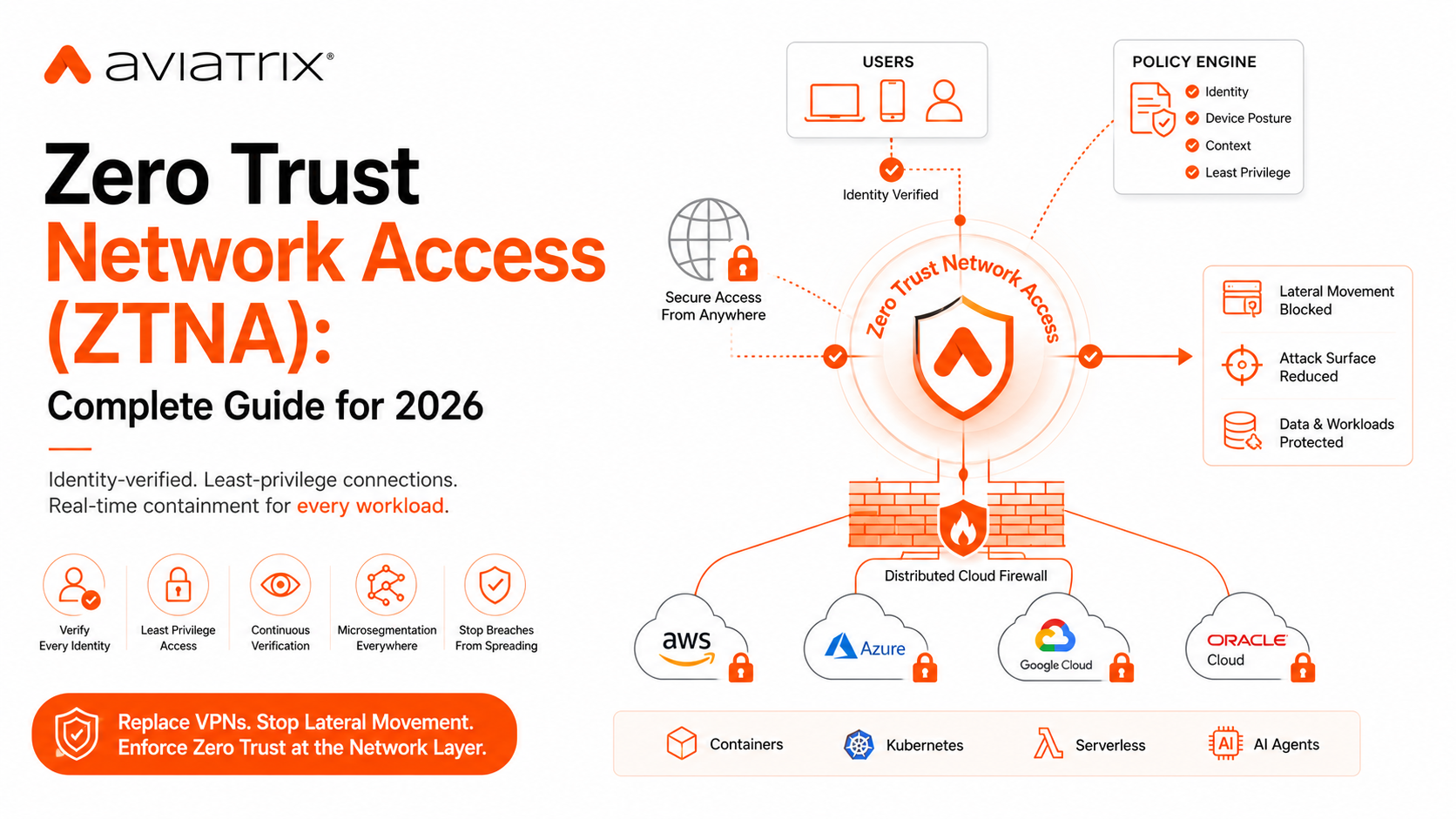
- Zero Trust network access replaces the "castle-and-moat" VPN model with identity-verified, least-privilege connections to specific applications rather than the entire network.
- Traditional VPNs expose organizations to lateral movement: 53% of enterprises breached via VPN had attackers traverse freely across their networks before anyone noticed.¹
- Cloud workloads require trust network access ZTNA enforcement at the workload layer, not just at the perimeter, where AI agents, containers, and serverless functions communicate constantly.
- The Aviatrix Cloud Native Security Fabric (CNSF) delivers network-layer ZTNA across AWS, Azure, GCP, and OCI without agents or code changes.
- The ZTNA market is projected to grow from $1.34 billion in 2025 to $4.18 billion by 2030, driven by the failure of perimeter security and the rise of hybrid work environments.2
- Zero Trust Network Access (ZTNA) replaces VPN-based access with identity-verified, least-privilege connections to specific applications and resources.
- ZTNA reduces lateral movement by limiting access only to authorized resources rather than exposing the broader network.
- Continuous verification evaluates identity, device posture, and context throughout a session, not just at login.
- Cloud-native environments require network-layer ZTNA to secure workload-to-workload communications and prevent unauthorized east-west traffic.
- Aviatrix Cloud Native Security Fabric (CNSF) delivers agentless, network-layer ZTNA across multicloud environments with real-time policy enforcement and containment.
Zero Trust network access is not a product. It is an architectural decision: stop granting broad access and start enforcing identity-verified, least-privilege connections to only the resources a user or workload actually needs. For cloud native enterprises running AI workloads, Kubernetes clusters, and multicloud environments, that shift now has to happen at the network layer itself, not just at the login screen. Aviatrix delivers that enforcement with the Cloud Native Security Fabric, applying ZTNA enforcement inline, across every workload, in real time.
What Zero Trust Network Access Actually Means
The Core Principle: Never Trust, Always Verify
Zero Trust network access operates on one rule: no user, device, or workload receives automatic access to anything. Every access request is verified against identity, device posture, and context before a connection is granted. The operative word is verify, not detect after the fact.
Traditional security models assumed anything inside the corporate network was safe. Zero Trust security rejects that assumption entirely. Trust is never implied by network location.
Zero Trust vs. VPN: The Structural Difference
VPN solutions grant broad access to the whole network. Once authenticated, a user or workload can reach large portions of the internal network, often far beyond what their role requires. ZTNA grants access to a specific application, verified at the moment of each access request, with nothing else reachable.
The security consequences are concrete. When VPN credentials are compromised, attackers move laterally through a flat network, escalating privileges and reaching sensitive data with few controls stopping them. With trust network access ZTNA, lateral movement is architecturally constrained. A compromised credential can only reach what the policy explicitly permits, and nothing else is visible to the attacker.
The numbers confirm it: 53% of enterprises breached via VPN vulnerabilities report attackers moved laterally across their networks, and 91% of security professionals say VPNs could lead to a serious breach in their environment.¹ That is not a configuration problem. That is the model failing.
Hybrid Work Environments and Why the Perimeter Failed
Why Remote Access Security Needs a New Model
Hybrid work environments shattered the concept of a perimeter. Employees access corporate applications from home networks, personal devices, and third-party locations. Contractors connect to sensitive systems from outside any controllable boundary. Legacy VPN solutions handle this by extending the corporate network outward, which extends the attack surface outward with it.
Secure remote access works differently in a Zero Trust framework. Instead of connecting a user to the network, trust network access ZTNA connects a user to a specific application, after verifying identity, device health, and behavioral context. The corporate network itself stays invisible. Only the resources the user is permitted to reach are accessible, and only for the duration of that verified session.
Hybrid Work Environments Are Driving ZTNA Adoption
The shift is accelerating. In 2025, global ZTNA adoption rose by 53%, with 80% of organizations embracing Zero Trust to secure cloud migrations and hybrid workforces.³ A separate survey found that 79% of organizations intend to implement a trust network access ZTNA solution as a replacement for VPN solutions within the next two years.⁴ The driver is not preference. It is the mathematical reality that perimeter security cannot contain what is already inside the network, and hybrid work environments guarantee that a stable perimeter no longer exists.
How Zero Trust Network Access Works
Identity-Based Access Control Over Network Location
The foundation of ZTNA is user identity and device security, not IP address or location. When a user or workload initiates an access request, the system checks who they are, the device health state, and whether behavior matches expected patterns. Only then is a connection granted to the specific resource requested, verified continuously, not just at login.
Continuous Verification and Device Posture
Standard perimeter tools check identity once. Zero Trust network access applies continuous verification throughout the session. If device posture changes or an access attempt targets a resource outside the policy scope, the connection is blocked or re-evaluated automatically. The session itself is the enforcement boundary, not just the moment of entry.
Multi-Factor Authentication as a Foundation
Multi-factor authentication is a required element of ZTNA, but not sufficient on its own. MFA verifies identity at login; Zero Trust network access extends verification across device security, behavioral context, and explicit policy to determine what the verified user or workload can reach.
Software-Defined Perimeter: No Broad Network Exposure
This model is often implemented as a software-defined perimeter. Instead of routing users onto the corporate network and trusting them to stay within boundaries, a software-defined perimeter makes the network infrastructure invisible. Applications are not reachable via open IP ranges. Users receive a direct, encrypted connection to the specific application they are authorized for. Nothing else is exposed, and attackers scanning the network find no surface to target.
Network-Layer ZTNA for Cloud Workloads
Why Cloud Workloads Change the Zero Trust Requirement
Most ZTNA frameworks were designed for a specific problem: providing secure remote access for human users connecting to private apps and corporate systems. That remains important. But cloud workloads introduce a second and more complex access challenge: the workload-to-workload communication layer.
In a cloud environment, applications are composed of hundreds of services, containers, serverless functions, and AI agents that communicate constantly. Each of those communications is a connection event. Most traditional security models treat that traffic as trusted by default once it is inside the virtual private cloud. That is where lateral movement and data exfiltration happen, and that is what perimeter-based tools cannot address.
Workload Identity and Granular Access Control
Securing cloud workloads requires granular access control policies applied to workload identity, not just user identity. A Kubernetes pod running an AI inference workload should only be permitted to reach specific LLM API endpoints and the vector database it was designed to query. It should not be able to reach credential stores, cloud management APIs, or external destinations outside its intended scope.
Applying Zero Trust access at this layer requires enforcement that understands workload metadata: pod labels, namespace, cloud resource tags, Lambda ARNs, and service account identity. Granular access control at this level is what blocks supply chain attacks, such as the March 2026 LiteLLM/TeamPCP incident, where trusted code inside trusted pipelines began exfiltrating credentials to attacker-controlled endpoints. Network-layer enforcement stops that traffic before it leaves the environment.
East-West Traffic and Lateral Movement
Lateral movement inside cloud environments almost always travels east-west: from one workload to another, across the internal network, using legitimate credentials stolen from one compromised component. Enforcing strict access controls on east-west traffic is the direct counter to that pattern.
Enforcing strict access controls on workload-to-workload traffic requires policy enforcement points that sit inline with that traffic, not at the perimeter edge. This is the core architectural gap that cloud native ZTNA closes, and it is the gap that most CNAPP and posture tools, which scan and alert but do not enforce, leave wide open.
Secure Access Service Edge and ZTNA
What Secure Access Service Edge (SASE) Means
Secure access service edge, or SASE, combines network security functions with wide-area networking capabilities into a single cloud-delivered framework. The access service edge architecture consolidates multiple security services, including Zero Trust network access, cloud access security brokers, secure web gateways, and firewall-as-a-service, under a unified policy and enforcement model.
ZTNA is a core component of any access service edge architecture. It provides the identity-aware, application-level access control layer that makes the broader secure access service edge framework functional. Without ZTNA enforcing granular access control on every connection, secure access service edge is networking infrastructure without enforcement logic.
SASE for Hybrid Work Environments and Cloud Security
The access service edge model is particularly relevant for hybrid work environments because security enforcement travels with the user, regardless of location, applying consistent conditional access policies whether someone connects from a corporate office, a home network, or a cloud environment. Combining secure access service edge with network-layer Zero Trust network access gives enterprises a unified security posture covering both the user access and workload communication layers.
Zero Trust Network Access: Core Security Benefits
Enhanced Security Through Least Privilege Access
Least privilege access is the organizing principle of ZTNA: users and workloads access only the resources they need, verified at the moment of the access request, with no residual or implicit trust extending beyond that. Enhanced security through ZTNA is measurable: organizations transitioning from VPN solutions to Zero Trust network access report a 73% improvement in their overall security posture.⁴
Reducing the Attack Surface
Traditional security models expose the entire network to any successfully authenticated user. ZTNA limits that exposure to only the applications each identity is authorized for. The attack surface shrinks from "everything connected to the network" to "only what this identity is permitted to reach." For cloud environments where AI workloads, containers, and third-party integrations continuously expand the reachable surface, limiting access through Zero Trust network access is an operational necessity.
Better Access Management and Visibility
Access management in a Zero Trust model is centralized and identity-driven. Policies apply consistently across every environment without individual firewall rules or per-device configurations. Conditional access policies evaluate identity, device posture, and behavioral context continuously, producing a complete audit trail of every access attempt, every granted connection, and every denial.
Data Security Through Containment
Data security in a Zero Trust architecture is a function of containment: the attack cannot reach the data if policy never permits the compromised workload to connect there. The data is protected because the breach path does not exist, not because the breach was caught quickly. This approach supports compliance requirements under HIPAA 2025, PCI DSS 4.0, DORA, and NIS2.
Get a personalized analysis in under 15 minutes.
ZTNA isn't just about replacing VPNs, it's about enforcing least-privilege access and preventing lateral movement across users, applications, and cloud workloads. Take the free ZTNA Readiness Assessment to evaluate your access controls, workload segmentation, remote access security, and cloud enforcement capabilities. →
How Aviatrix Delivers Network-Layer Zero Trust Network Access
The Cloud Native Security Fabric (CNSF)
Aviatrix built the Cloud Native Security Fabric to deliver Zero Trust network access at the layer where cloud workloads actually communicate: inline, at every VPC boundary, across every cloud. The CNSF is not a perimeter gateway or a user-facing VPN replacement. It is enforcement embedded into the cloud fabric itself, applying Zero Trust network access controls to every workload-to-workload and workload-to-internet session in real time. The platform is agentless, requires no code changes, and applies unified policy across AWS, Azure, GCP, and OCI from a single control plane. Learn more about Aviatrix Zero Trust for Workloads.
SmartGroups: Workload Identity Over IP
Aviatrix CNSF uses SmartGroups to resolve workload identity from cloud native metadata: Kubernetes pod labels, namespaces, cloud resource tags, Lambda ARNs, and service accounts. Because identity is tag-based rather than IP-based, granular access control policies stay accurate as ephemeral workloads spin up, scale, and terminate. This is the workload-layer equivalent of identity-based access controls for human users. The policy knows which workload is making the access request and enforces accordingly, continuously, without manual rule updates as environments change.
WebGroups: Defined Permitted Destinations for AI Workloads
For AI workload infrastructure, Aviatrix maintains WebGroups: managed, auto-updated lists of permitted egress destinations for every major LLM provider, vector database, MCP gateway, and embedding service. An AI workload permitted to reach avx-ai-llm-providers can connect to approved model APIs. It cannot reach attacker-controlled endpoints, even if the code running inside the workload has been compromised. The egress path to unapproved destinations does not exist at the network layer. This is how Aviatrix contained the March 2026 LiteLLM supply chain attack for customers before credentials left the environment. Learn more about Zero Trust for AI Workloads.
Distributed Cloud Firewall: Enforcement at Every Workload
The Aviatrix Distributed Cloud Firewall (DCF) enforces trust network access ZTNA policies at the VPC boundary, where egress actually happens. DCF combines SmartGroup identity with WebGroup destination control into permit/deny rules applied at every workload across every cloud. Default-deny is the starting state: every workload begins denied, and approved paths are explicitly added. Explore Aviatrix Zero Trust for Networking.
NIST SP 800-207 and CISA ZTMM 2.0 Alignment
Aviatrix CNSF operationalizes NIST SP 800-207 and CISA ZTMM 2.0, delivering distributed Policy Enforcement Points, centralized policy engine, identity-driven segmentation, and FIPS-validated encryption across every cloud. Learn more about Aviatrix's Zero Trust initiative.
Deploying ZTNA Solutions in Enterprise Cloud Environments
What Deploying ZTNA in Enterprise Cloud Requires
Deploying ZTNA solutions does not require ripping out existing infrastructure. Aviatrix CNSF integrates with existing cloud deployments, applies policies without agents or code changes, and supports log-only mode for observation before enforcement. Granular access control rollout typically starts with high-risk workloads or AI infrastructure, where the combination of sensitive data access and third-party dependencies creates the highest exposure.
Continuous Monitoring in Practice
Continuous verification in an Aviatrix CNSF deployment means every egress event is evaluated against current policy, logged, and attributed. If a workload begins contacting destinations outside its permitted set, the DCF blocks the connection and generates a telemetry record. This is not detection-and-response. It is enforcement that prevents the traffic from completing.
For security teams in regulated industries, this continuous monitoring produces audit-ready telemetry covering every access attempt and every blocked egress path, aligned to reporting requirements across major compliance frameworks. Explore the Zero Trust for every workload resource for deployment guidance.
Conclusion
ZTNA has moved from a framework concept to an operational requirement. VPN solutions cannot contain lateral movement. Perimeter tools cannot stop supply chain attacks that arrive through signed, trusted code. Cloud workloads need enforcement at the layer where they actually communicate, not a gateway they can bypass.
Aviatrix CNSF delivers ZTNA enforcement across every workload, every cloud, and every access request, without agents, code changes, or re-architecture. Compromised workloads cannot reach destinations they were never permitted to access. That is what Zero Trust network access looks like when enforced at the network layer, not just promised at the policy layer.
See how network-layer Zero Trust network access can contain your cloud attack surface.
About Aviatrix
Aviatrix is the Cloud Native Security Fabric company, delivering runtime containment for cloud workloads across AWS, Azure, GCP, and OCI. The Aviatrix platform enforces Zero Trust network access inline, without agents or code changes, stopping lateral movement, data exfiltration, and supply chain attacks before they spread. Aviatrix serves 500+ enterprise customers, including roughly 10% of the Fortune 500, and was recognized on the Deloitte Technology Fast 500 in 2025.
References
https://www.zscaler.com/blogs/security-research/new-vpn-risk-report-56-enterprises-attacked-vpn-vulnerabilities
https://www.marketsandmarkets.com/Market-Reports/zero-trust-network-access-ztna-market-23387374.html
https://www.snsinsider.com/reports/zero-trust-network-access-market-9039
https://www.cybersecurity-insiders.com/vpn-exposure-report-2025-why-organizations-are-adopting-a-modern-secure-access-strategy/
https://www.globenewswire.com/news-release/2025/12/17/3206791/0/en/Zero-Trust-Network-Access-Market-to-Hit-USD-14-74-Billion-by-2033-Driven-by-Rising-Cybersecurity-Threats-and-Remote-Work-Adoption-Research-by-SNS-Insider.html
Frequently Asked Questions
Ready to Move from Zero Trust Access to Zero Trust Enforcement?
ZTNA is more than identity-based access. Effective Zero Trust requires continuous enforcement across users, applications, and cloud workloads to stop lateral movement and contain threats in real time.