
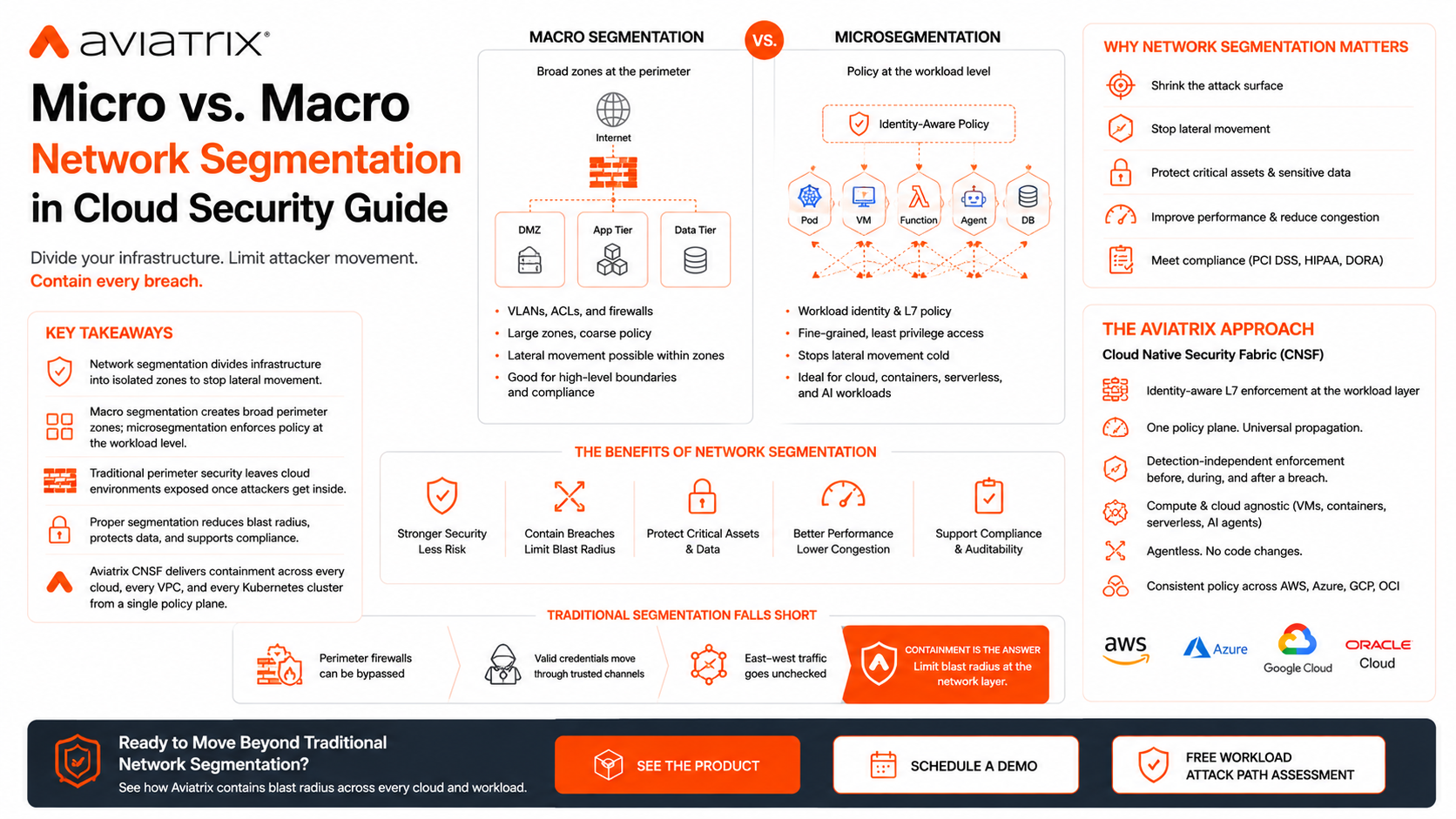
- Network segmentation divides infrastructure into isolated zones so a breach in one area cannot spread freely across critical assets.
- Macro segmentation creates broad perimeter zones; microsegmentation enforces policy at the individual workload level, dramatically reducing Blast Radius.
- Traditional approaches relied on hardware boundaries and perimeter firewalls; modern clouds require identity-aware, detection-independent network security enforcement.
- Proper network segmentation supports compliance requirements like PCI DSS and limits lateral movement after a breach.
- Aviatrix's Cloud Native Security Fabric delivers containment across every cloud, every VPC, and every Kubernetes cluster from a single policy plane.
- The difference between macro segmentation and microsegmentation, and when each approach is most effective.
- How network segmentation reduces blast radius and prevents lateral movement after a breach.
- Why traditional perimeter-based segmentation struggles in cloud, multicloud, Kubernetes, and AI environments.
- How to design identity-aware segmentation policies that follow workloads instead of static IP addresses.
- Practical steps to implement network segmentation in modern cloud environments while supporting security, compliance, and operational efficiency.
Introduction
Network segmentation is the practice of dividing a computer network into isolated zones with defined access control policies governing what each zone can reach. In modern cloud environments, that practice has become critical not just for reducing network congestion but for containing breaches that arrive through trusted code, valid credentials, and supply-chain dependencies that traditional perimeter defenses cannot intercept. This article explains the difference between macro and microsegmentation strategies, the benefits of network segmentation in multicloud architectures, and how to start deploying segmentation without disrupting operations.
What Network Segmentation Is and Why It Matters Now
At its core, network segmentation breaks a large, flat network into smaller, controlled zones. Each zone has explicit policies that authorize specific workloads, users, and services to communicate with specific destinations. Everything else is blocked by default.
The business case is straightforward. A flat network with no internal boundaries gives an attacker who compromises one workload a free path to every other system on the network. Network segmentation removes that free path. Containing the breach to a single network segment keeps critical systems, sensitive data, and customer records out of reach.
Network security in this model is not just about stopping attackers at the perimeter. It is about ensuring that when a workload is compromised, the resulting network traffic is governed by explicit policy rather than being permitted everywhere. That distinction is what separates a contained incident from a catastrophic breach.
Implementing network segmentation was simpler when infrastructure lived in a physical data center. Today, workloads span multiple cloud providers, Kubernetes clusters, serverless functions, and AI agents, all communicating across dynamic, ephemeral paths that traditional segmentation tools were never designed to govern.
Macro Segmentation: Broad Zones at the Perimeter
Macro network segmentation draws large organizational boundaries around sections of infrastructure. A common example is isolating a PCI DSS-required cardholder data environment from general business systems, or separating a production environment from a development environment.
Traditional network segmentation at this scale relied on virtual local area networks, access control lists at network chokepoints, and perimeter firewalls. This model is reasonable for establishing high-level compliance boundaries and reducing exposure between major environment tiers.
The limitation is scope. Macro segmentation leaves large attack surfaces inside each zone. Once an attacker moves past the perimeter, internal systems within the same network segment are often reachable without further restriction. Lateral movement through management ports, shared credentials, and east-west network traffic patterns within a zone goes unchecked.
Microsegmentation: Enforcement at the Workload Level
Microsegmentation reduces the granularity of policy enforcement from broad perimeter zones down to individual workloads. Instead of governing which large zone can talk to which other zone, microsegmentation controls which specific workload identity can communicate with which specific destination, on which protocol, at Layer 7.
The practical improvement is significant. Microsegmentation converts lateral movement from a structural advantage for attackers into a structural disadvantage. A compromised container cannot reach adjacent services without an explicit policy permit, even if those services share the same VPC or subnet.
Implementing network segmentation at the microsegmentation level requires policy that follows workload identity rather than static IP addresses. In cloud environments, network addressing schemes shift constantly as workloads scale up and down. A policy anchored to an IP address becomes stale within hours. A policy anchored to a workload identity, a Kubernetes label, or a cloud account tag remains valid regardless of where or how often the workload moves.
The Benefits of Network Segmentation in Cloud Environments
Improved Security and a Smaller Attack Surface
Network segmentation reduces the number of paths available to an attacker after gaining access. Strict access controls mean that compromised credentials in a development workload cannot reach production databases or customer data repositories without crossing an explicit policy permit that does not exist.
Stopping Lateral Movement Cold
Lateral movement is how breaches scale. An attacker compromises a single workload, harvests credentials, and uses them to access adjacent systems. Proper network segmentation blocks this pattern by requiring explicit authorization for every workload-to-workload communication. No permit, no movement.
Protecting Critical Assets and Sensitive Data
Isolating sensitive data stores and critical systems behind granular access control policies makes those assets structurally harder to reach. Even an insider threat or a compromised service account with broad network access faces additional barriers at every controlled boundary.
Reducing Network Congestion and Supporting Network Performance
Segmented architecture channels traffic into defined lanes and eliminates unnecessary broadcast traffic across the entire network. Network performance improves because routing decisions are cleaner, monitoring is more focused, and network monitoring tools operate on targeted flows rather than undifferentiated traffic.
Meeting Compliance Requirements
Regulations including PCI DSS require that cardholder data environments be isolated from other network infrastructure. Healthcare data, government systems, and financial records carry similar mandates. Network segmentation provides auditable access control lists and traffic flow records that map directly to compliance reporting requirements.
Logical Segmentation vs. Physical Segmentation
Physical segmentation uses separate hardware, switches, and routers to create boundaries. It is expensive, inflexible, and irrelevant once an attacker establishes a foothold on any physical host inside the boundary.
Logical segmentation enforces boundaries in software. Virtual local area networks were the first widely deployed logical segmentation model. Software-defined networking (SDN) extended that model by allowing network administrators to define and update boundaries programmatically without hardware changes.
In cloud environments, logical segmentation through software-defined networking means that access points are governed by identity-based policy rather than physical port assignments. A workload migrating across availability zones retains its segmentation context because policy tracks identity, not location. This is the foundation that makes microsegmentation practical at cloud scale.
Network Infrastructure Challenges in Multicloud Segmentation
Multicloud environments break traditional network segmentation strategies in a predictable way: each cloud provider has its own native networking constructs, and policies defined in one cloud do not automatically apply in another.
Organizations running workloads across AWS, Azure, and Google Cloud often end up with fragmented access control lists spread across three separate policy management interfaces. Inconsistencies appear. Attack surfaces widen at the seams between clouds. Network administrators spend significant time reconciling rules that should be uniform but are not.
Effective network segmentation across multiple clouds requires a unified policy plane that sits above individual cloud providers. One rule change propagates across all providers, regions, and clusters simultaneously. Without that, the human error rate in maintaining consistent policy across distributed networks remains unacceptably high.
Where Traditional Segmentation Falls Short: The Credential Vector
Traditional network segmentation concentrated enforcement at chokepoints: firewalls and inspection appliances positioned at known traffic crossing points. If traffic did not cross the chokepoint, it was not inspected.
Cloud east-west traffic frequently bypasses these points entirely. Serverless functions, managed services, and cross-VPC native paths skip centralized inspection by design.
The credential vector compounds this problem. Research from Mandiant indicates that the majority of cloud intrusions in 2026 arrive via valid credentials moving through legitimate channels, generating no anomalous signal.1 Detection tools cannot flag normal-looking network traffic. A network segmentation approach that enforces policy regardless of whether a breach has been detected is the only control that reliably contains credential-based attacks. Waiting for an alert that will never arrive is not a security strategy.
Access Control Policies: The Foundation of Effective Segmentation
Network segmentation without enforceable access control policies is a planning document, not a security control. The policies must run in the data plane, enforcing on every flow, not just recording exceptions in a log.
Access control policies for effective network segmentation should be default-deny. Anything not explicitly permitted is blocked. They should be identity-aware at Layer 7, operating on workload identity and protocol rather than IP addresses and ports. And they should cover both egress and lateral movement. Data exfiltration flows outbound. Controlling internal network traffic without controlling what workloads can reach externally leaves the most common exfiltration vector open.
Network security requires that every network segment enforce policy on every flow, not just on flows that happen to cross a monitored chokepoint. A policy that governs 90% of paths is one that attackers route around.
Implementing Network Segmentation: A Practical Starting Point
Implementing network segmentation in a cloud environment is most successful when approached in phases that limit risk at each step.
Inventory first. Map every workload, access point, and external dependency before writing a single policy. You cannot segment what you have not cataloged.
Monitor before enforce. Deploy controls in logging-only mode. Observe actual traffic flows, identify legitimate communications that a default-deny policy would block, and resolve exceptions before activating enforcement.
Start with highest-risk zones. Critical systems, cardholder data environments, and AI workloads with broad cloud permissions are the right first targets. Reducing Blast Radius around these assets delivers immediate value.
One zone at a time. Implement changes to one controlled zone before moving to the next. A misconfigured policy in one zone should not affect the rest of your network infrastructure.
Internal Segmentation and the AI Workload Problem
AI workloads create a category of internal segmentation challenge that did not exist three years ago. They are ephemeral, making agent-based enforcement unreliable. They are highly privileged, carrying credentials that grant access to broad sets of cloud resources. They ship quickly, often outpacing manual security reviews.
The LiteLLM supply chain attack in March 2026 illustrated the specific risk. A widely used middleware library was poisoned to silently exfiltrate credentials to an external attacker-controlled site. Organizations with network segmentation enforcement at the workload egress level automatically blocked exfiltration because outbound communication to the unauthorized destination was prohibited by policy, regardless of whether the attack had been detected.2 Organizations without that enforcement had credentials leaving their environments with nothing to stop it.
Internal segmentation for AI workloads must be compute-model agnostic to be effective. Serverless functions and managed services cannot run agents. Policy must apply at the network layer, following workload identity, to cover the full AI attack surface.
How Aviatrix Approaches Network Segmentation
Aviatrix's Cloud Native Security Fabric delivers network segmentation enforcement across every workload communication path in a cloud environment, without requiring agents, appliances at chokepoints, or manual policy updates per cloud provider. One policy change propagates universally across providers, regions, and clusters.
The Cloud Native Security Fabric is identity-aware at Layer 7, so access control policies track workload identity rather than IP addresses. It is detection-independent, enforcing before, during, and after a breach. And it is compute- and model-agnostic, governing VMs, containers, serverless functions, and AI agents from the same policy plane.
For organizations starting their segmentation journey, the Workload Attack Path Assessment is a free, agentless evaluation that maps how real attacks would move through your cloud environment today, surfaces actual Workload Breach Chains, and feeds findings directly into enforcement policy.
Learn more about the platform and how cloud network segmentation works.
Conclusion
Network segmentation remains the most reliable architectural control for containing breaches, protecting sensitive data, and stopping lateral movement. Modern cloud environments demand identity-aware, detection-independent, compute-model-agnostic enforcement that operates at the workload level rather than at the perimeter. Every network segment must enforce explicit policy on every flow, governing network traffic before, during, and after a compromise. The organizations that implement network segmentation with that level of granularity will have structurally smaller Blast Radii, faster containment, and more defensible compliance postures than those still relying on perimeter firewalls and fragmented access control lists. The Containment Era has arrived. Network segmentation is what it requires.
About Aviatrix
Aviatrix is pioneering the Cloud Native Security Fabric (™), the architecture the Containment Era requires. The Cloud Native Security Fabric governs every workload communication path across every cloud, every VPC, every Kubernetes cluster, and every serverless function, from a single policy plane. One rule. Universal propagation. Enforced at the workload, not at a chokepoint. Trusted by more than 500 of the world's leading enterprises. For more information, visit aviatrix.ai
References
https://www.mandiant.com/m-trends
https://aviatrix.ai/threat-research-center/
https://www.pcisecuritystandards.org/
https://nvlpubs.nist.gov/nistpubs/SpecialPublications/NIST.SP.800-125B.pdf
https://www.cisa.gov/sites/default/files/publications/Zero_Trust_Maturity_Model.pdf
Ready to Move Beyond Traditional Network Segmentation?
Most organizations have network segmentation. Few have true containment. Once attackers gain access, flat trust zones, inconsistent multicloud policies, and unrestricted east-west traffic allow breaches to spread.