
Set what each workload may reach. Block everything else.
Aviatrix Clearance gives every cloud workload a cleared list of what it may reach, Outbound Containment to egress internet traffic and Lateral Containment between workloads. Everything else is blocked, enforced in the network with nothing to install on the workload.
 Estimate your Blast Radius
How much of your cloud can one compromised workload reach?
Start with the shape of your estate and get a number. Then answer five questions and watch it move. No form, nothing to deploy.
1Size your estate
Pre-filled for a typical estate. Change the VPC count and the rest follows, or set each one.
2Shrink it: how your policy holds up
Five questions that decide how far a compromised workload can get. Each answer you can show shrinks your Blast Radius. How the five are tested
Optional: tick what you run and we suggest answers, shown outlined. Click any answer to set your own.
- 1Path-complete
Does your policy cover every way a workload can leave or move?
To the internet, to other VPCs, to on-premises and to partners.
Why it matters
If it is open: Exfiltrates on a path that never touches the inspection point. No enforcement event fires.
Change Healthcare, 2024. One stolen credential, no MFA, nine days of unrestricted movement across paths no inspection point ever saw. 190M records. Source: Picus Security
- 2Identity-aware at Layer 7
Can policy follow the workload, not its IP address?
Written on workload identity and protocol, and still holding when the address changes.
Why it matters
If it is open: Uses the rule you wrote. Allow 443 to github.com permits their repo as easily as yours.
Shai-Hulud, 2025. The npm worm used each victim’s own token to create a public GitHub repo and commit the harvested secrets: exfiltration over allowlisted github.com. Source: Wiz
- 3Detection-independent
Does it block before anything is detected?
Enforcement that holds during a compromise nobody has spotted yet.
Why it matters
If it is open: Logs in with a valid credential through a legitimate channel. Nothing to detect, so nothing to enforce.
Snowflake / UNC5537, 2024. 165 organizations breached with valid stolen credentials and no malware, including AT&T, Ticketmaster and Santander. Source: Mandiant
- 4Compute-model agnostic
Does it reach serverless, managed services and partners?
The places no agent can be installed, covered in production today.
Why it matters
If it is open: Lands where no agent can run. Highest privilege, lowest enforcement.
Capital One, 2019. A server-side request forgery reached the EC2 metadata service, yielding IAM credentials, then 106M records from S3, a managed service where no host agent runs. Source: Appsecco
- 5Universally propagated
Does one change apply everywhere within seconds?
Every cloud, region and cluster, with no lag after a revocation.
Why it matters
If it is open: Keeps the path you already closed. Every lag in propagation is a window where intent and enforcement disagree.
Cloudflare, 2023. Believed every Okta-leaked credential was rotated; one service token was missed. The policy in force lagged the policy intended. Source: Cloudflare
The cloud is not misconfigured. It was never configured.
Egress control and segmentation are not new. Nobody has rolled them out across the cloud because a bad firewall change breaks production, so workloads keep reaching the internet, databases and each other on paths no firewall governs.

Data leaving on paths the perimeter never sees
Workload traffic leaves through NAT gateways and route tables, not the perimeter firewall, which watches people and the front door while workloads leave by the back.

AI agents reaching more than their job needs
Agents that share a security group share a source address, so each one inherits the reach of its most permissive neighbor and nobody can say which agent did it.

Kubernetes pods leaving through node NAT
Pod egress exits through platform-managed NAT gateways and never crosses a central firewall, and policy tied to addresses breaks when pods move.
Enforced in the network without breaking production
No agents to install, nothing to detect first, and every step is reversible.
See every workload and every path
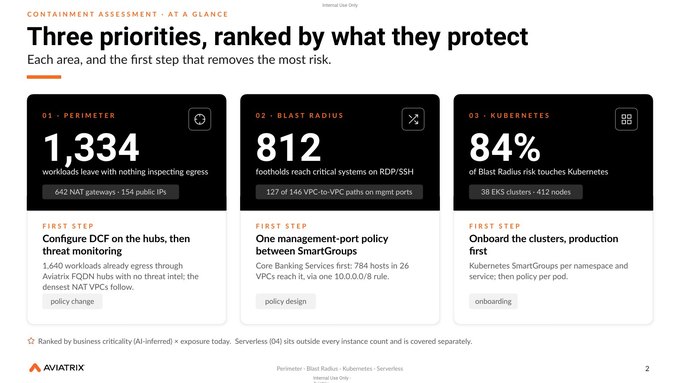
The Containment Assessment shows every workload, every path and every AI agent no one authorized, and what a compromise could reach.
Insert with one toggle per VPC
Transparent insertion, with no agents, no network redesign and original addresses preserved end to end.
Watch before you enforce
Start in monitor mode, where the Shadow Rule Set shows every connection the policy would have blocked, then promote one policy at a time. Backout is one action.
Keep it current without a ticket queue
Aviatrix Active Defense capabilities come to Aviatrix Clearance in the first quarter of 2027 and keep clearance current as the estate changes, inside guardrails the team sets.
The two controls of Aviatrix Clearance, and the layer that comes to them
A compromised workload can move two ways, out of the estate or sideways to anything else in it. One control covers each direction and the layer keeps both current.

Aviatrix Active Defense
The autonomous defense layer of the Aviatrix Containment Platform.
Its agents build a model of your estate from the estate itself, with no tagging project and no inventory to import, and draft the policy each application needs. They prove each policy in monitor mode on live traffic, so your team sees what would have been denied before anything is. Every policy they write is standard policy your team can read, change or back out in one action.
Aviatrix Active Defense capabilities come to Aviatrix Clearance in the first quarter of 2027. In free early access today for design partners on Aviatrix Enterprise.
Ask your account team about the design partner program
Outbound Containment
Governs egress. A workload reaches only the outside destinations it is cleared for, named by domain rather than IP, with default deny at every workload and no central firewall in the path.

Lateral Containment
Governs east-west. A workload reaches only the other workloads it is cleared for, by identity, across VPCs and clouds, down to the pod, the function, the database and the AI agent.
AI agent discovery and containment runs inside both controls at the agent grain. Priced per workload, and free to every enterprise through May 1, 2027.
Every AI agent cleared for its own job, not its neighbor’s
Agents are discovered from flow and DNS, including the ones no one authorized, and contained inside both controls at the agent grain. No SDK, no code change.

Discover
Gateway-free discovery of every AI agent in your cloud from flow and DNS analysis, with the mode each one runs in.

Contain
Default-deny outbound for AI agents with Aviatrix-managed AI WebGroups, and lateral clearance by identity down to the agent.
Attribute
Where agents share an interface, flows attribute to the interface and the product says so. Public-mode agents with no interface in your VPC are named as out of reach.
Security sets the policy and developers never feel it
Enforcement sits at the VPC boundary where egress actually happens, transparent to the workload, so nothing in the build, the deploy or the application changes.

Nothing in the pipeline changes
No agents, no SDK, no code change and no proxy to configure. Original addresses are preserved end to end, and the same policy is orchestrated into security groups and Kubernetes NetworkPolicy where a gateway is not needed.

Policy as code, owned by security
Clearance is written once on workload identity and lives in Terraform and Kubernetes custom resources. Domains resolve automatically and tags keep groups current, so a new service ships with its clearance instead of a ticket.

Enforce without a change window
Start in monitor mode, read the Shadow Rule Set, promote one policy at a time and back out in one action. Aviatrix Active Defense capabilities come to Aviatrix Clearance in the first quarter of 2027 and keep clearance current as developers ship, inside guardrails your team sets.
You already have partial containment
A next-generation firewall, a user-access proxy or a posture tool each cover part of the problem, and none of them governs the paths a cloud workload actually uses to leave. Measure your stack and Aviatrix Clearance against the same five testable properties.
| Property | Firewall appliances in the cloud | Posture tools without enforcement | Host-agent segmentation | Aviatrix Clearance |
|---|---|---|---|---|
| Path-complete, every path a workload can use is governed | ✕ No | ✕ No | ✕ No | ✓ Yes |
| Identity-aware at Layer 7, policy on workload identity and protocol, not IP | ✓ Yes | ✕ No | ✕ No | ✓ Yes |
| Detection-independent, holds whether or not anything was detected | ✓ Yes | ✕ No | ✓ Yes | ✓ Yes |
| Compute-model agnostic, reaches VMs, pods, functions and AI agents with nothing installed on the workload | ✕ No | ✕ No | ✕ No | ✓ Yes |
| Universally propagated, one policy change lands in every cloud and cluster | ✕ No | ✕ No | ✕ No | ✓ Yes |
| Containment delivered | 2 of 5 | 0 of 5 | 1 of 5 | 5 of 5 |
Every one of them misses outbound. Workload egress leaves through NAT gateways and route tables, never crossing the appliance or the proxy, and a posture tool reports it without stopping it. Outbound Containment closes that path and replaces the NAT gateway spend while it does.
Built on the Aviatrix Containment Platform
Aviatrix Clearance runs on the Aviatrix Containment Platform, built on the Cloud Native Security Fabric, and is the second post-quantum offering on the fabric. The platform sets what every cloud workload may reach before any attack and enforces it in the network, at every workload and in every cloud. The Cloud Native Security Fabric is quantum safe.
Whoever owns the workload has a reason to start
Close the gap without risking production
Monitor first and see exactly what would happen before enforcing anything, free through May 1, 2027 and every action reversible.
Start free and enforce when your own numbers say so
The Containment Assessment is free to anyone, and Aviatrix Clearance is free to every enterprise through May 1, 2027.

Blast Radius Calculator
An estimate from what you tell us, with peer benchmarks and what one policy would remove.
Estimate it
Containment Assessment
Your Blast Radius measured from your own configuration, read-only and agentless, with the first step that removes the most risk.
Measure yours
Clearance Incident Response
Outbound, lateral and intrusion prevention across your whole estate, with no workload cap, from November 1 through May 1, 2027. Start in monitor mode, watch the Shadow Rule Set, and enforce when nothing you need is on the list. Enroll through AWS Marketplace.
Join the programAfter May 1, 2027, the Free Tier includes a free Containment Assessment and 15 workloads you can run in monitor or enforce mode, with no purchase and no time limit. Fifteen workloads cover a typical VPC or VNet. Contact Aviatrix for pricing beyond that.
See what every workload can reach, free, in 60 seconds
The Blast Radius Calculator estimates what one compromised workload can reach, with no procurement and no budget approval. Aviatrix Clearance is free to every enterprise through May 1, 2027, so you have time to patch.