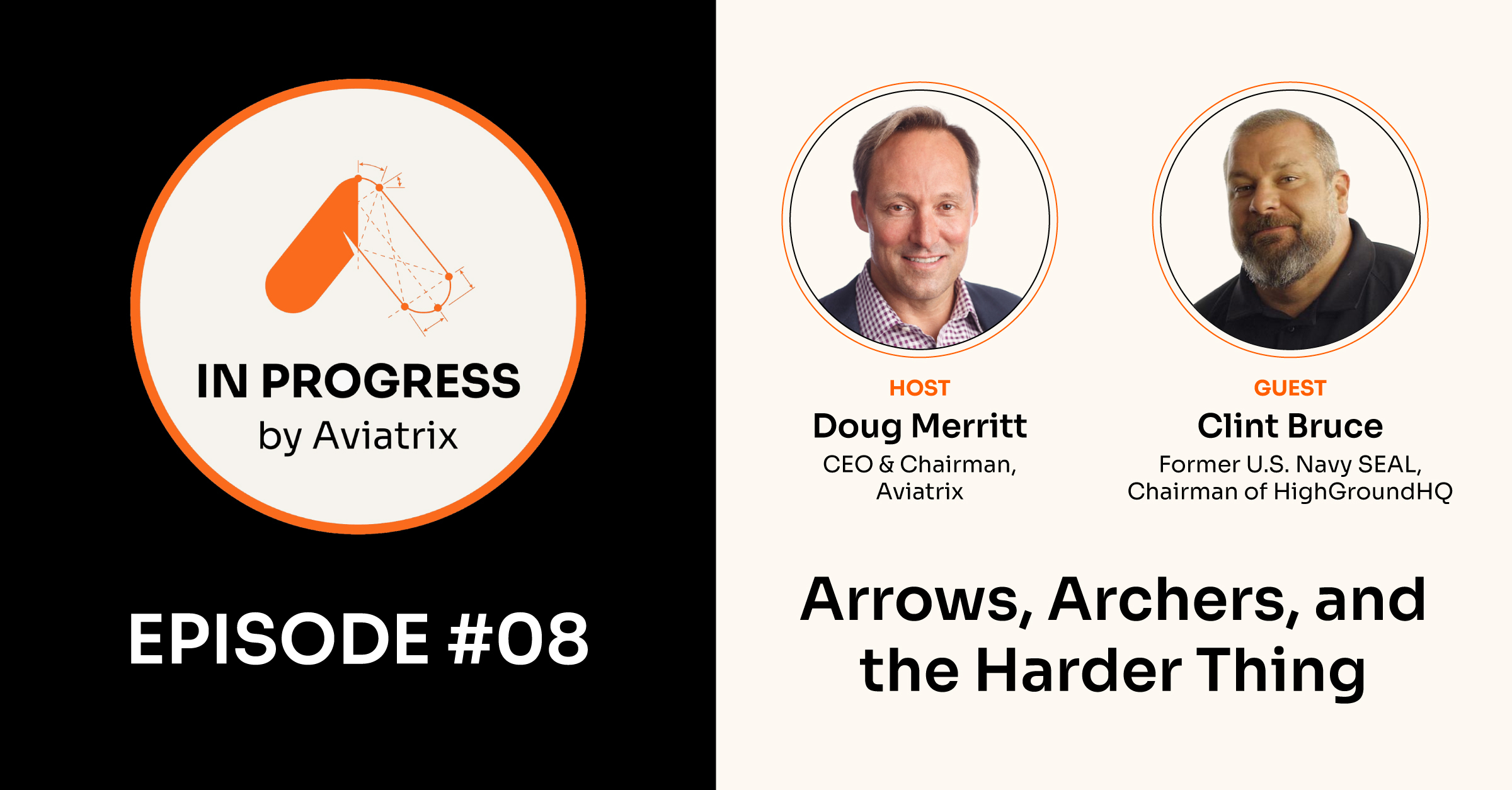
In the latest episode of In Progress, host Doug Merritt, CEO of Aviatrix, sits down with Clint Bruce: Naval Academy football captain, Baltimore Ravens linebacker, Navy SEAL, and founder of the nonprofit Carry The Load. They talked about making hard choices, the role of talent, and leadership.
From a Middle Linebacker for the Ravens to Navy SEAL
Clint was excited to make the Ravens as a middle linebacker. The problem was the other middle linebacker, a second-year player named Ray Lewis. “It might be easier to become a Navy SEAL than beat out Ray Lewis,” Clint remembers thinking at practice one day. He admired how Lewis grew “from being a talented player into a dedicated pro."
After his father died, Clint chose the Naval Academy partly to take care of his mother, sister and brother. He was then picked as one of 16 graduates to pursue becoming a SEAL, so both childhood dreams sat in front of him. “The way to figure out what you really want is to hold both things that you think you want in your hand,” he said. “And the one will just kind of appear brighter."
When in Doubt, Do the Harder Thing
At any crossroads, as long as the choice is moral, legal, and ethical, Clint takes the harder path. “At worst, you’re going to learn a lot about yourself,” he said.
His new wife backed him, even though it meant trading an NFL rookie minimum of about $400,000 for about $26,000 a year. But as he thought about it, the trade was worth it: “I’m not talented enough to do anything exceptional for any period of time absent passion,” he said. He knew he had made it into the NFL already, but the question that would have haunted him was whether he could have made it through SEAL training.
When Doug asked where the philosophy came from, Clint pointed to the family members, farmers, coaches, and teachers he grew up around, who finished one hard thing and found the next. “It wasn’t hard for hard’s sake,” he said. “It was virtuous and purposeful and meaningful and would benefit others.”
“My Gift Is Not Being Gifted”
Doug asked Clint about an unusual statement he made: “my gift is not being gifted.” “By design, I’ve chosen environments where I have to work hard to keep up,” Clint explained. In eighth grade, he was the fifth-string fullback on a team with three fullbacks.
Instead of quitting, he wrote a formula on a card he still has: “angles plus allies plus advantages equals achievements.” Angles means cutting friction. Allies means surrounding yourself with people who mean what they say. Advantages means knowing your strengths and partnering with people who have the ones you lack.
“I look at talent as a credit line that you steward,” he said. You can’t control what talent you have, but you can steward what you’re given. He has watched gifted NFL players and SEAL candidates break the first time they weren’t the fastest in the room, and calls that “an exposure issue,” not a character flaw. Hitting his limits early gave him years to build a system and choose the hard thing.
Who Are You Carrying?
Carry The Load started with anger. Clint felt the country wasn’t honoring Memorial Day well, and he was angry at himself for not honoring it until he started losing friends. “What you can choose is to make that anger righteous or to let it become reckless,” he said.
Today the nonprofit holds events every May, and fellow SEAL Stephen Holley runs it. Clint sees business success as fuel for missions like it: “For me, money is bullets.” “The more bullets I have, the more targets I can take down.”
The idea behind the walks is simple: walk next to someone and ask who they’re carrying. “If you’re doing life well, you’re carrying someone or being carried by somebody,” Clint explained.
The Archer and the Arrow
Doug raised a touchy topic in tech: when founders should hand off the company. Clint said building and leading are different jobs. “An arrow makes an impact wherever it hits,” he said. “An archer makes a difference wherever they aim.”
“If you’re promoted, you’re going to get promoted away from the thing you’re good at,” he said. In his workshops, leaders learn to make the shift in four steps: talent, train, task, trust. He spoke about the importance of not letting the “tyranny of the urgent drive the train”: instead, “ask this talent that you've selected and built to do the right things.”
He once told a head coach who had hired a strong offensive coordinator that he was finally in command. “If your head’s down looking at the map, you’re in control. If your head’s up looking at the problem, you’re in command” (27:05). Doug agreed both roles matter: “You need a commander and the controller."
Not Wrong, Just Early
Doug compared football’s fast, clear feedback with the slow, murky feedback of corporate life. Clint said that gap made his first seven years after the military the loneliest of his life. On the field he got feedback “every seven seconds.” In business, “it’s going to take you five years to figure out if you’re wrong or not."
That view let him be patient without lowering his standards, and taught him the difference between wrong and lost. “Sometimes I’m not wrong, I’m just early,” he said. He’s fine being wrong as long as he has a map. He argued that smooth sailing should make you nervous. “The total absence of resistance is an ambush,” he said.
“Camelot With a SWAT Team”
Doug praised the chapter Clint wrote in a book by John Kindervag, the creator of the Zero Trust model. Clint called Zero Trust an ideal end state that no one fully reaches. “Zero Trust is Camelot, and you guys are SWAT,” he told Doug.
Doug agreed. “Our life doesn’t operate without trust,” he said. “So there’s always a semblance of trust. How do you bound it?"
Clint closed with a note on self-awareness for leaders: “If you’re an arrow and you love being an arrow, then don’t tell yourself you should be an archer now."
Ready to see Aviatrix in action?
Get a personalized live demo walkthrough or explore our latest deep-dive cloud threat research intelligence.
Gartner Strategic Roadmap for Zero Trust Security Programs 2025 Report
Download and gain actionable insights to advance your cloud security strategy.