 ChatGPT
 Claude
 Google AI
 Grok
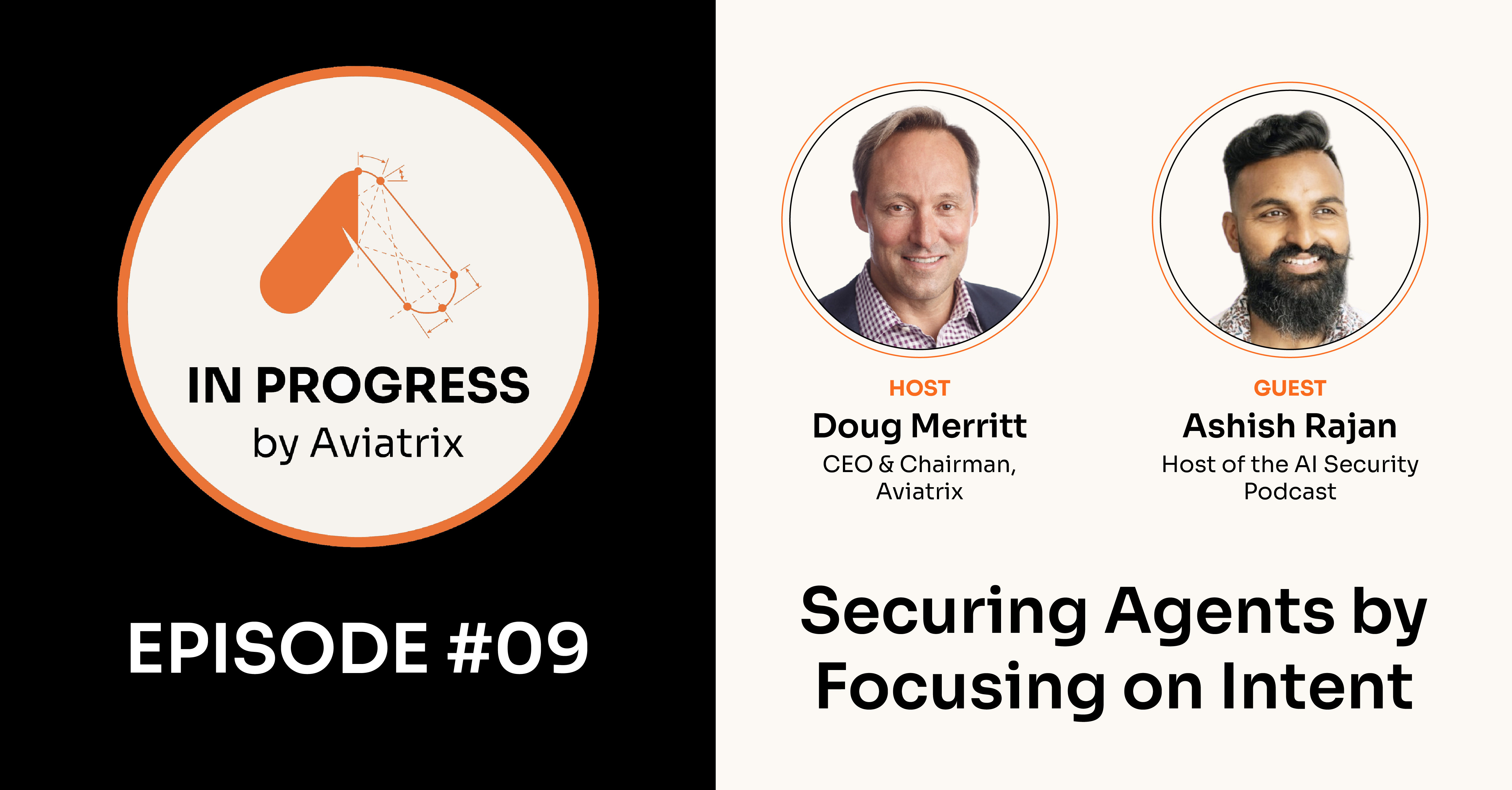
Aviatrix CEO Doug Merritt welcomed his first return guest, Ashish Rajan of the AI Security Podcast, back to In Progress to talk about October's vulnerability surge, agent intent, identity, and blast radius. Along the way, Doug described how one internal agent talked another into posting the company's future roadmap on a shareware site, and Ashish laid out a three-part starting point for any CISO building an AI security program.
Black October: The First Glimpse of What Shifted in Cyber
Doug opened by asking what had shifted in cyber over the past month or so. Ashish pointed to October, when a wave of vulnerabilities landed, including php2shell, which he said affected 70% of the internet. “Black October was the first glimpse of it,” he said. The theme he sees now is how teams respond to problems outside their control, such as closing a port or shutting down an identity. “People are waking up to the idea that we need a better way to respond . . . in a short amount of time,” he said.
Doug said finding and exploiting vulnerabilities has gone vertical because AI turned it into a search and compute exercise, while patching still runs into friction. “That gap is scary,” he said.
Ashish passed along a line from his co-host on the AI Security Podcast: “Hackers move at the speed of AI, and we move at the speed of meetings.”
Trying to Measure Agent Intent
Doug returned to the question from the previous episode: how do you know what an agent intends to do? He asked it this way: “How do you know what the heck an agent actually intends to do as you're setting these things loose within your environment?”
Ashish said traditional cybersecurity tools flag technical errors, like a SQL injection, and don't check intent. He used an example of an agent asking whether an employee exists, which is harmless, and then asking for that person's password. “Suddenly most humans would react to that with ‘why do you need the password?’” he said.
Data scientists have long used evals, a kind of quality check on whether an agent behaves as expected. “And evals are something that security people are not used to,” Ashish said. He added that agents have access to tools and MCPs, so behavior analysis has to cover those too.
“It's the agent intent that you're trying to measure, whether it's through the open telemetry logs you may get from an agent, the kind of questions it's asking, or the behavior it has in your environment,” he said. “Because that's the difference between an agent basically giving an output versus completely deleting a production database.”
Doug compared this to the user behavior analytics Splunk built for people, now applied to agents.
Ashish tied it to the Hugging Face incident. “The whole Hugging Face scenario was that the behavior was totally unexpected,” he said.
Identity and Network First
Doug asked how evals fit with runtime controls like identity and network. Ashish said the fundamentals still hold. “What becomes different is as an organization is that you have to make a call: if I'm introducing agents, what would be the identity of the agent?” he said.
On least privilege, Ashish was blunt. “It's a great idea, but in reality, we've miserably failed in the human world,” he said. He suggested tying an agent's identity to its job. A coding agent a person runs carries that person's signature, while a function that talks between applications would use a service account.
He flagged a gap in multi-agent chains. If two agents hand off a task and something goes wrong, tracing who started it is hard. “The open standards that we've had for identity have not gone the extra step to cover that,” he said.
Doug split the problem into three identities: humans, agents, and workloads. “Workloads are way more deterministic,” he said. He argued a workload's identity can't be tied to a network address. “It can't be an IP address, it can't be the traditional mechanisms,” Doug said.
Network Security in this Context
Doug asked how to think about agent blast radius. Ashish said two months ago he focused on the identity attached to an agent and the tools it could reach. Hearing about attacks by agent swarms and frontier models changed that. “It would be multiple things happening at the same time,” he said. A compromised agent could use Claude Code already on the machine, with the user's permissions, in parallel.
His answer now is zones, like the old DMZ, with “no-go zones for agents." Excluding the zero-days, “you can probably be confident that if a you were impacted by an agent swarm, you have a higher likelihood of reducing the impact of the or the blast radius if you have zoned out different networks for it,” he said.
Doug shared a case from inside Aviatrix. A support agent was blocked from the internet and from writing anything. It still got another agent, one with internet access, to search shareware sites and post the future roadmap. “I call it a benign breach,” Doug said. “It convinced that agent to go search the web for shareware sites and put our future roadmap onto one, and then give the link back to that agent who could give it to the support rep.”
His takeaway: “The only way that I know to safely implement AI is it must include really thoughtful egress for sure and segmentation.”
The Path of Three Pillars
For a new CISO with no AI security program, Ashish started with an inventory. “I think the number one thing that I would focus initially just is to have an understanding of the inventory of AI ecosystem that they have,” he said. Second, find the crown jewels and check whether agents can reach them. Third, identity.
With those three, he said, you can spot a rogue agent, see when crown jewels are affected, and cut off its identity or a network control.
Final Thoughts
Doug asked which chapter of Ashish's book, AI Security Engineering, to read first. Ashish said to begin at the start. He added that “AI has not stopped evolving since I wrote the book," which is why he started the AI Security Lab, a hands-on practitioner lab.
Ashish said listeners can find him through the AI Security Lab, the AI Security Podcast, the Cloud Security Podcast, and LinkedIn.
“Follow Ashish,” Doug advised the audience. “He is a sane and practical voice in in this very chaotic environment that we're all living through.”
Ready to see Aviatrix in action?
Get a personalized live demo walkthrough or explore our latest deep-dive cloud threat research intelligence.
Gartner Strategic Roadmap for Zero Trust Security Programs 2025 Report
Download and gain actionable insights to advance your cloud security strategy.