

Identity tools answer one question: who is asking? Zero Trust security answers a second question most cloud environments leave unguarded: what can they reach once they are in? The gap between those two questions is where modern cloud breaches live.
Key Takeaways
Identity tools verify credentials at login but cannot control what a valid session does after access is granted across cloud workloads
A Zero Trust security model requires network-layer enforcement at every workload, not just authentication gates at the perimeter
Zero Trust architecture must be detection-independent: 82% of intrusions use valid credentials that produce no anomalous signal
Least privilege access applied at the workload level limits Blast Radius before a breach spreads, not after detection
Validated Containment Architectures translate Zero Trust into deployable blueprints for the AI workloads and platforms enterprises are actually running
The Identity Tool Gap in Cloud Security
Identity tools have become the default answer to cloud security. IAM platforms, single sign-on providers, and posture scanners now sit in front of nearly every enterprise cloud environment. Security teams trust them to enforce who gets in. Most of the time, they do that job reasonably well.
The problem is that the threat moved. Attackers who want access to cloud workloads are not trying to forge credentials at the front door. They are compromising software that already has valid credentials and using those credentials to move inside the cloud undetected. A Zero Trust model built only on identity verification has no answer to that problem.
What Identity Tools Can and Cannot Do
Identity tools authenticate users at login and flag anomalous account behavior. Multi-factor authentication makes credential theft harder to exploit. Posture scanners catch misconfigurations before attackers do.
None of those controls govern what a workload communicates with after authentication. An application server with a valid service account credential can reach a database, a cloud storage bucket, a third-party API, and an AI agent endpoint simultaneously. If one of those connections is unauthorized, identity tools cannot block it. The credential is legitimate. The communication goes through.
Why the Zero Trust Security Model Requires More Than Authentication
Zero Trust is often framed as an identity problem: verify every user, apply scoped permissions, eliminate implicit trust in accounts. That framing is partially correct and completely insufficient for cloud workloads.
Zero Trust security requires that every communication between workloads be explicitly authorized, not just every login. Zero Trust must reach the network layer, where workload-to-workload traffic, egress to external services, and lateral movement between cloud resources actually happen. Identity tools operate above that layer. They cannot see it, and they cannot enforce policy on it.
Mandiant's M-Trends 2026 report confirms the consequences. In 2026, 82% of intrusions rode valid credentials through legitimate channels, producing no anomalous signal that identity or detection tools could act on.¹ When the credential is valid, the identity tool sees a normal session. The breach is already inside.
Zero Trust Architecture for Cloud Workloads
How Traditional Network Security Models Fail at the Workload Layer
Traditional network security models assumed that the perimeter was the enforcement point. Firewalls at the edge, VPNs for remote access, network segmentation by subnet. That model worked when applications lived in data centers and traffic flowed in predictable patterns between defined zones.
Cloud workloads communicate differently. A containerized application might talk to a managed database in one region, a serverless function in another, an AI agent endpoint across a VPC boundary, and a third-party API over the public internet, all in the same transaction. Traditional network security models have no way to enforce Zero Trust policy across that topology. Every inspection point becomes a chokepoint that traffic routes around.
Zero Trust architecture rejects the perimeter assumption entirely. It enforces policy at the workload, not at the edge. Every communication path available to a workload is governed by explicit policy, whether that path passes through a centralized inspection point or bypasses it entirely.
Applying Zero Trust Architecture Inside the Cloud
This means governing east-west traffic, egress to external services, and workload-to-workload communication from a single policy plane, without requiring agents on every pod, container, or serverless function.
Genuine enforcement reaches every path available to every workload. If a path exists, policy governs it. This is what Zero Trust network access means in a cloud context: not just VPN replacement for remote workers, but per-path authorization for every communication a workload can initiate. Zero Trust network access applied inside the cloud closes the enforcement gap that identity tools leave entirely uncovered.
NIST 800-207 defines Zero Trust architecture as a set of principles requiring that access to resources be granted only after verifying the identity, authorization, and integrity of a request, on every request, not just at session start.² The framework NIST 800-207 describes is not an identity framework. It is an enforcement framework that happens to start with identity.
The Blast Radius Problem Identity Tools Cannot Solve
How Lateral Movement Exploits the Identity Gap
When a cloud workload is compromised, lateral movement turns a single exploited credential into a broader breach. The compromised workload uses its existing access to reach adjacent systems and harvest more credentials. Every resource it can communicate with is part of the Blast Radius.
Identity tools cannot limit Blast Radius because they do not control what valid sessions can communicate with after authentication. The session is authorized. The credential is real. Every move the attacker makes through the compromised workload looks like normal application traffic.
The LiteLLM breach in March 2026, which Aviatrix calls The Cascade, demonstrated this directly. A poisoned dependency pushed malicious code into AI middleware used across roughly 36% of cloud environments.³ The code exfiltrated AWS, GCP, and Azure credentials through legitimate channels. Detection tools had nothing to trigger on. The credentials were valid. The breach spread until exfiltration was noticed externally.
Network-Layer Enforcement as Blast Radius Control
Blast Radius is the set of systems, data, and functions that compromised workload code can reach. Reducing Blast Radius requires controlling what each workload can communicate with at the network layer, before a breach occurs.
Zero Trust at the network layer enforces egress policy on every workload. When a compromised workload attempts to send credentials to an unauthorized destination, the connection is blocked. Not because a detection tool flagged something anomalous. Because the destination was not on the explicit allow list. That is the difference between zero trust and detection-dependent security. Zero trust blocks the exfiltration. Detection records it.
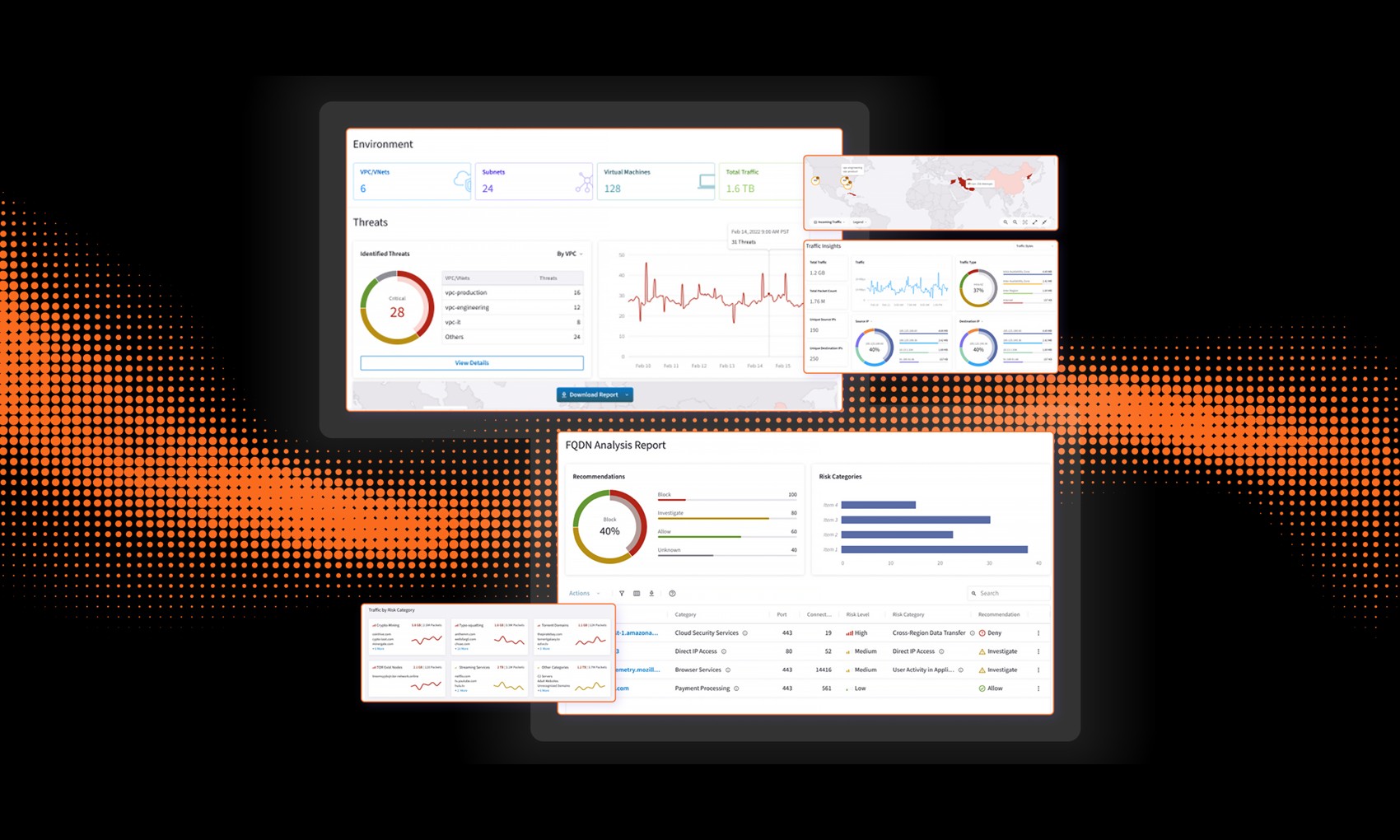
The Cloud Threat Command Center maps Blast Radius exposure in real time, connecting live threat intelligence to enforcement across cloud environments.
Core Principles of Zero Trust Security for Cloud Workloads
Least Privilege Access at the Workload Level
Least privilege access is one of the foundational principles of Zero Trust, and it applies to workloads just as much as to users. An application server should only be able to communicate with the specific services its function requires. A data pipeline workload should only have egress to its designated storage destinations. An AI agent should only reach the model endpoints and data stores that its authorized tasks require.
Applying scoped permissions at the workload level means a compromised workload can only exfiltrate or move laterally within its permitted scope. Zero Trust requires that scoped permissions be enforced at the network layer, not just declared in an IAM policy. Without network-layer enforcement, IAM-declared permissions are advisory, not controlling.
These permissions reduce the risk of credential compromise by ensuring stolen service account credentials cannot unlock resources beyond what policy explicitly permits. Applying scoped access consistently across cloud workloads directly shrinks the potential Blast Radius of any breach.
Continuous Monitoring and Verification
Zero Trust requires continuous verification, not a verified-at-login, trusted-until-logout model. For cloud workloads, this means every outbound connection, API call, and service-to-service request is evaluated against policy at the time it occurs.
Continuous monitoring in a Zero Trust model does not mean anomaly detection alone. It means runtime enforcement against an explicit policy baseline. The difference matters: anomaly detection looks for behavior that deviates from a learned normal. Continuous monitoring in Zero Trust blocks behavior that is not on the explicit allow list, regardless of whether it looks normal.
Microsegmentation and Secure Zones
Microsegmentation divides cloud environments into isolated security zones, limiting what any one workload can communicate with even if that workload is compromised. In a Zero Trust network, these rules enforce at the policy level across every cloud provider, every VPC, and every Kubernetes cluster from a single control plane.
When every workload can only reach explicitly permitted destinations, a compromised workload's impact is bounded to its segment. Microsegmentation helps contain security breaches by ensuring lateral movement cannot cascade beyond a defined boundary.
What the Zero Trust Model Requires at the Network Layer
Zero Trust Network Access vs. Identity-Only Access Control
Zero trust network access grants access only to the specific resource being requested, not to the network that resource sits on. This distinction matters enormously for cloud workloads. Traditional access control grants a workload access to a network segment. Zero Trust network access grants a workload access to a specific endpoint, on a specific protocol, for a specific purpose.
This architecture creates the lateral movement problem. Once a workload is inside a permitted segment, everything in that segment is reachable. The Zero Trust model built on Zero Trust network access eliminates that assumption. Access to one resource does not imply access to adjacent resources. Every path is governed independently.
The Trust Security Model Must Be Detection-Independent
The most significant limitation of the trust security model that most cloud environments currently run is its dependency on detection. The trust security model assumes that when credentials are misused, something anomalous will happen: a login from an unusual location, a request outside of business hours, a volume pattern that triggers an alert.
The Cascade proved that assumption cannot hold against supply chain attacks. Read the full threat response analysis to see what the 2026 threat reports say about this shift. When the credential is valid and the communication channel is trusted, the trust security model built on detection has nothing to act on.
A Zero Trust security model that is detection-independent enforces explicit communication policy on every path, regardless of whether a breach has been confirmed. Enforcement does not wait for an alert. The workload either has an explicit permit to communicate with the destination, or the connection is blocked. That is what Zero Trust security delivers that a trust security model based on detection cannot.
Validated Containment Architectures: Zero Trust Principles Made Deployable
What Validated Containment Architectures Deliver
Understanding Zero Trust is different from deploying it. Most organizations adopt a Zero Trust strategy at the policy level but never operationalize it at the workload level. The gap between the stated strategy and the running environment is where exposure lives.
Aviatrix addresses this with Validated Containment Architectures: lab-tested blueprints that deliver a complete insertion pattern, SmartGroup model, and baseline Distributed Cloud Firewall policy pack for a specific named AI platform. Each Validated Containment Architecture ships with a bill of materials and infrastructure-as-code repository so security teams deploy containment in hours, not quarters.
Learn more about Validated Containment Architectures and the deployment cadence currently underway across the AI platforms enterprises are running.
Zero Trust Architecture for AI Workloads Specifically
AI workloads present a specific enforcement challenge that identity tools cannot meet. They are ephemeral: containers and serverless functions spin up faster than agent-based tools can configure. They are highly privileged: AI agents often hold credentials for multiple services simultaneously. They ship fast: deployment velocity outpaces manual security review on nearly every team.
These three properties make AI workloads the highest-risk gap for teams relying on identity tools and agents. Neither can govern network-layer communication after authentication.
The program currently covers AWS Bedrock AgentCore, Azure AI Foundry, Google Vertex AI, Microsoft MCP Gateway, OBOT, and GitHub Actions, with weekly releases across a 12-week cadence. Each blueprint delivers workload-level enforcement that agent-based and identity-based approaches cannot reach: identity-aware at Layer 7, detection-independent, and universally propagated from a single policy plane.
Implementing Zero Trust Security for Cloud Workloads
Zero Trust implementation for cloud environments does not require a full replacement of existing controls. The practical starting point is discovery: inventorying which workloads exist, what they communicate with, and what credentials they hold. From there, scoped access policies limit each workload to only the connections its function requires.
The Cloud Native Security Fabric deploys as a transparent sidecar at the VPC level, governing every flow in and out without requiring application changes. A single policy enforces across every cloud, every region, and every cluster in subseconds. Teams begin in a monitoring-only state, validating policy before any blocking occurs, then flip to enforcement with a single configuration change.
Each Validated Containment Architecture provides the specific insertion pattern and policy baseline for the platform being secured, so the deployment path is defined before work begins.
Benefits of Zero Trust Architecture Across Cloud Environments
Applying Zero Trust to cloud workloads delivers measurable improvements. Blast Radius shrinks because scoped permissions limit what any compromised workload can reach. Lateral movement stops because Zero Trust network access enforces per-path policy. Breach cost drops: research shows Zero Trust reduces the average cost of a data breach by $1.5 million.
This approach also produces an explicit communication map of every cloud environment, which becomes the foundation for compliance reporting and incident investigation.
Conclusion
Identity tools answer the front-door question. Zero Trust security for cloud workloads answers what happens inside. That gap is where most breaches live, and no identity tool can close it.
The Cloud Native Security Fabric closes it at the network layer, enforcing Zero Trust policy at every workload communication, on every path, independent of detection. Validated Containment Architectures make Zero Trust deployable for the specific AI platforms enterprises are running now, as a first-week commitment, not a future project.
Contact Aviatrix to operationalize Zero Trust security for your cloud environment.
References
https://www.crowdstrike.com/en-us/blog/crowdstrike-2026-global-threat-report-findings/
https://www.mandiant.com/m-trends
https://doi.org/10.6028/NIST.SP.800-207
https://aviatrix.ai/blog/threat-response-2026-containment/
https://www.ibm.com/reports/data-breach
Frequently Asked Questions
Zero Trust security for cloud workloads enforces explicit communication policy at every workload, on every path, independent of whether a breach has been detected. It extends Zero Trust past the identity layer to the network layer where workload traffic actually moves.
Zero Trust architecture enforces policy on what a valid session can communicate with after authentication. Identity tools only verify who is asking. The Zero Trust model closes the gap they leave at the workload-to-workload and workload-to-internet layers.
Least privilege access in a Zero Trust security model restricts each workload to only the specific resources its function requires, enforced at the network layer. If credentials are stolen, the attacker can only reach what the explicit policy permits.
Validated Containment Architectures translate Zero Trust principles into deployable blueprints for specific AI platforms. Each blueprint delivers a complete Distributed Cloud Firewall policy pack so security teams operationalize Zero Trust for a named platform in hours, not quarters.
Ready to see Aviatrix in action?
Get a personalized live demo walkthrough or explore our latest deep-dive cloud threat research intelligence.
Gartner Strategic Roadmap for Zero Trust Security Programs 2025 Report
Download and gain actionable insights to advance your cloud security strategy.