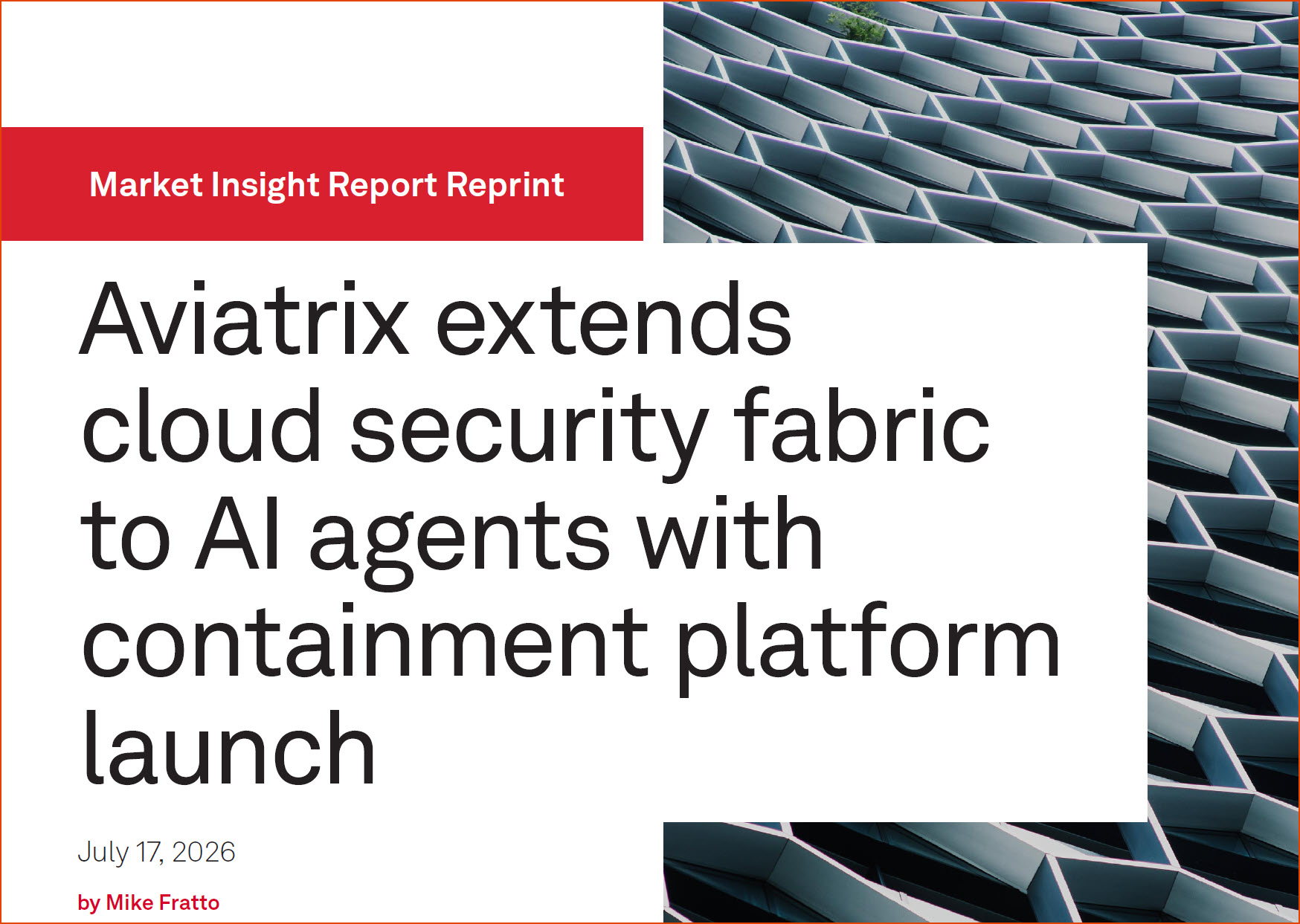
In a recent report for 451 Research, Mike Fratto profiled the Aviatrix solution, the first containment platform with governance for AI agents. Fratto highlighted Aviatrix’s unique strengths as a cloud native security enforcement platform, including:
Multicloud support – Aviatrix enforces security policies at the network layer for the major cloud service providers: AWS, Microsoft Azure, Google Cloud Platform, and Oracle Cloud Infrastructure.
Communication governance with distributed enforcement – Aviatrix Cloud Native Security Fabric protects all workloads, including Kubernetes, serverless, and AI, across north-south and east-west traffic flows without forcing traffic into centralized chokepoints.
Agentless containment – Aviatrix prevents data exfiltration without requiring agents or application changes.
The key to Aviatrix's differentiation is containment through architecture: Cloud Native Security Fabric that establishes communication governance over all traffic flows. This 451 Research Report highlights the characteristics that make Cloud Native Security Fabric a Containment Platform: architectural enforcement across every workload, every path, independent of detection, even as rapidly-developing agentic AI and LLM platforms introduce new security risks.
From Cloud Networking to Cloud Native Security Enforcement: Protection through Architecture
Fratto gives an overview of the history of Aviatrix from a networking vendor to cloud native security enforcement platform. The report details the product offerings that we launched as we refocused on cloud security, including the Aviatrix Threat Research Center, a cloud security research hub, and Zero Trust for AI Workloads, which provides communication governance for AI workloads. It highlights our Cloud Native Security Fabric, our containment architecture for distributed policy enforcement, as the "core" of our agentless containment strategy and provides a detailed overview of how provides holistic, distributed, and multicloud protection.
The report names the supply chain attacks of March 2026, what we call the Cascade, as the market context for Aviatrix's shift to containment vs. detection as the ideal cloud security approach. The speed and success of that attack proved that detection tools are no longer fast enough; organizations must start with containment.
How Aviatrix Enforces Security
Fratto explained the products within the Aviatrix Cloud Native Security Fabric enforcement architecture that protect networks from data exfiltration, including:
SmartGroups – Cloud native tags and labels that create workload identities that organizations can use to create intent-based policies that can govern all workloads, including ephemeral ones like Kubernetes containers.
Distributed Cloud Firewall – Enforces policies at the workload instead of a centralized chokepoint.
Zero Trust for AI Workloads – Provides communication governance for AI agents, LLM proxies and agentic frameworks.
Validated Containment Architectures – Default-deny, lab-tested containment blueprints for specific AI platforms such as AWS Bedrock AgentCore.
The key to these product offerings is agentless, default-deny, network-layer enforcement that enforces policies based on dynamic, cloud-agnostic attributes instead of static IP addresses, closing the blind spots and security gaps that compromised AI agents could exploit.
"Aviatrix’s differentiation rests on its agentless network-layer enforcement model and its native support for ephemeral workload types, including Kubernetes pods and serverless functions, that agent-dependent platforms cannot consistently govern," Fratto said in the report.
Aviatrix Differentiators: Multicloud and Communication Governance
The report examines Aviatrix’s SWOT (Strengths, Weaknesses, Opportunities, Threats), focusing on differentiators like Aviatrix’s ability to offer multicloud security policy enforcement from a single data plane and communication governance for all workload types. These advantages simplify threat containment for Aviatrix customers who can review threats through one simplified interface, while knowing that their security policies are being enforced in the runtime for every workload.
Why Rising Cybersecurity Threats Demand an Architectural Solution like Aviatrix Cloud Native Security Fabric
The cybersecurity headlines this year have been a running list of new threats and innovations with fantastic names. Threat actors who use AI like TeamPCP, LAPSUS$, and Scattered Spider, as well as unprecedented AI innovation with releases like OpenClaw, Mythos, Fable, and Glasswing, have each had a ripple effect on vulnerability management and patching, lateral movement risk, and security strategies. The landscape is changing quickly, and many security teams are scrambling to keep up with patching, let alone finding a new long-term strategy for threat management.
The 451 Research Report analyzes Aviatrix's architectural solution to the problem of AI-accelerated threats: instead of adding another bolt-on security solution or requiring companies to rip-and-replace their security stacks, Cloud Native Security Fabric embeds security policy enforcement in the network layer. The barrier of Aviatrix Distributed Cloud Firewall holds whether or not detection tools caught malicious traffic. Default-deny egress stops data exfiltration even when an attacker has used AI to chain together several zero-day vulnerabilities or stolen credentials to infiltrate the system in minutes.
Containment at the network layer is the architecture organizations need to prevent data exfiltration as agentic AI and LLMs continue to make vulnerability discovery, credential theft, lateral movement, and phishing attacks easier.
Schedule a demo to see Aviatrix Cloud Native Security Fabric in action.
Ready to see Aviatrix in action?
Get a personalized live demo walkthrough or explore our latest deep-dive cloud threat research intelligence.
Gartner Strategic Roadmap for Zero Trust Security Programs 2025 Report
Download and gain actionable insights to advance your cloud security strategy.