 ChatGPT
 Claude
 Google AI
 Grok
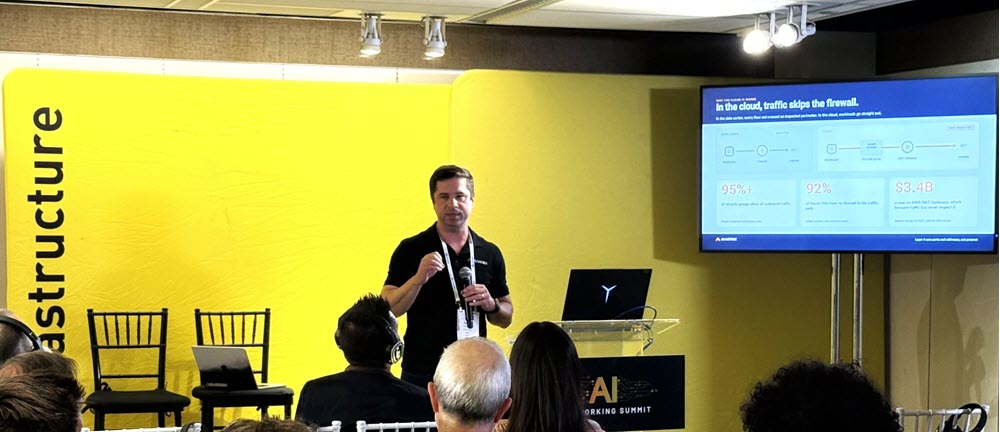
On Oct. 30, 2026, Aviatrix presented to the delegates at Security Field Day 16, Tech Field Day's security event. The 90-minute session ran in three parts: a product demo, the business, case, and an internal case study that I presented.
All three of our sessions rested on one premise: when prevention fails and detection is too slow, containment decides whether the incident becomes a catastrophic breach.
Chris McHenry: A Live View of Containment
Chris McHenry, Aviatrix's Chief Product Officer, opened the session with the problem. An attack does not stop when someone exploits a vulnerability. What the compromised workload can reach decides the damage, so network-level containment is the main control left once prevention fails. Cloud estates are open by default.
Chris made a sobering statement: he said that cloud network security is the worst he has seen in twenty years. Aviatrix has examined hundreds of cloud estates through our free Containment Assessment, and more than 95% of the default cloud controls we’ve seen allow unfettered internet access. About 2% of AWS spend goes to NAT gateways that provide unprotected egress.
He then described the Aviatrix Containment Platform, built on the Cloud Native Security Fabric, in three layers. A multicloud control plane discovers cloud native workloads and is built for infrastructure as code and policy as code. An agentless data plane, the Aviatrix gateway, is built on extended Berkeley Packet Filter (eBPF) and enforces policy from Layer 3 through Layer 7. An upcoming agentic layer, Aviatrix Active Defense, will automate policy discovery and upkeep.
The demo followed the four buyer stages in order:
See. Onboarding produced a free inventory of virtual machines, Kubernetes, and serverless functions. An egress score ranked segments by workload count and business criticality. Flow logs and Domain Name System (DNS) logs tied traffic to workloads and surfaced unauthorized AI use. The Containment Assessment graph showed outbound and lateral exposure.
Insert. Gateways went into existing traffic paths, either replacing the network address translation (NAT) gateway for outbound traffic or inspecting traffic between workloads, with no network redesign. Each step had a quick rollback.
Enforce. SmartGroups built policy from tags, Kubernetes namespaces and operating system metadata. Policy covered Layer 4 ports through Layer 7 functions such as URL filtering, intrusion prevention, decryption and blocking Tor exit nodes. Monitor mode tested each rule against live traffic first. Promoted rules cut off command-and-control traffic, rogue DNS and exfiltration while approved application flows kept running.
Operate. A Terraform provider and a Kubernetes integration let application teams commit policy through their own pipelines, inside Open Policy Agent guardrails. When a pod scaled to 10 instances, its SmartGroup updated immediately.
The demo also showed Aviatrix Active Defense moving segments from learning to monitor to enforcement, weighted by business criticality. Aviatrix Active Defense is a separate product, in free early access for design partners on Aviatrix Enterprise today. Aviatrix Active Defense capabilities come to Aviatrix Clearance in the first quarter of 2027. Aviatrix Clearance today is two controls, Outbound Containment and Lateral Containment, and intrusion prevention comes with both.
Willie Tejada: The Case for Containment
Willie Tejada, Aviatrix's Chief Marketing Officer, argued that boards need a business number for what one compromise can reach, tracked next to the patching numbers they already see. He pointed to recent incidents in which the damage came after the first exploit:
A malicious LiteLLM release on Oct. 21, 2026, installed a credential stealer targeting cloud, developer and AI-tool secrets. It was the project's second compromise of 2026.
Researchers found weak private keys in eight eMudhra intermediate certificates on Oct. 17, 2026, and Google, Mozilla, Apple and Microsoft moved to block them.
CISA added the PHP2Shell flaws to its Known Exploited Vulnerabilities catalog in October 2026.
Binance estimated the impact of its October 2026 breach at about $6.3 billion. Its initial investigation pointed to a compromised engineer's laptop.
His measure is Reachable Value at Risk, the expected annual loss from what an adversary can reach. It multiplies the value of a system by the share reachable at runtime, the probability of compromise and how much the loss grows while access persists. Willie placed it beside common vulnerabilities and exposures (CVE) counts and time to patch, not in place of them. It supplies the loss magnitude input to Factor Analysis of Information Risk (FAIR) which prices risk by loss frequency and magnitude.
He worked an example at the scale of the 2023 MGM Resorts attack, which the company estimated would cost about $100 million in Adjusted Property EBITDAR. Reducing how much of the estate one compromise can reach, and how long it can reach it, shrinks that number.
Willie assigned owners to each part of the metric. The Chief Information Security Officer owns the Blast Radius metric. The Chief Information Officer owns the architecture changes that reduce reach. The investment case runs through Durable Risk Reduction. His advice to boards was to track CVE counts, time to patch and Reachable Value at Risk together, quarter over quarter.
Matt Snyder: Funding the Work that Lasts
As a co-author of the Blast Radius Economics paper and Senior Manager of the Detection and Response team at Aviatrix, I showed how my team applies it. AI is speeding up attackers, so a security program should fund controls that hold across many attack waves instead of work that has to be redone after each one. I contrasted “sandcastles,” impressive-sounding projects that cannot withstand patient attackers, with “seawalls” that can endure persistent attacks.
My team uses Durable Risk Reduction to score every project on reach removed, durability, effort, technical debt and cost. Ongoing cost carries a three-year multiplier to match typical replacement cycles. A decision not to act is scored too, as accepted risk. Replacing standing administrator rights with just-in-time access landed in the top band: a large reduction that lasts, at modest cost. Writing new security information and event management (SIEM) rules landed in the lowest band, because the reduction is small and the upkeep is high.
I built an agent to score my team's third-quarter backlog, then reviewed and adjusted the results. Three projects reached the top band, and most of the backlog scored as short-lived. I described the rules that follow: harden first, buy new tools only when they harden, and ship every detection rule with a response plan and automation so detection does not add technical debt. The scoring agent and a GitHub repository are open for other teams to use.
Watch the full recording of Security Field Day 16.
References
Tech Field Day. “Aviatrix Presents at Security Field Day 16.” Oct. 30, 2026. https://techfieldday.com/appearance/aviatrix-presents-at-security-field-day-16/
Tech Field Day. “Securing the Agentic Frontier at Security Field Day 16.” Oct. 22, 2026. https://techfieldday.com/2026/securing-the-agentic-frontier-at-security-field-day-16/
Datadog Security Labs. “LiteLLM supply chain compromise: What you need to know.” Oct. 21, 2026. https://securitylabs.datadoghq.com/articles/litellm-compromised-pypi-docker/
Business Today. “BT Explainer: Why Google, Apple and Mozilla took action against eMudhra certificates.” Oct. 21, 2026. https://www.businesstoday.in/india/story/bt-explainer-why-google-apple-and-mozilla-took-action-against-emudhra-certificates-562837-2026-10-21
BankInfoSecurity. “PHP2Shell Actively Exploited, US Cybersecurity Agency Warns.” Oct. 27, 2026. https://www.bankinfosecurity.com/php2shell-actively-exploited-us-cybersecurity-agency-warns-a-33219
ABC News. “FBI says North Korea responsible for Binance breach.” Oct. 31, 2026. https://abc7news.com/story/binance-estimates-security-breach-impact-63-billion/19999397/
U.S. Securities and Exchange Commission. “MGM Resorts International Form 8-K.” Oct. 5, 2023. https://www.sec.gov/Archives/edgar/data/789570/000119312523251667/d461062d8k.htm
FAIR Institute. “Factor Analysis of Information Risk (FAIR) Standard v3.0.” January 2025. https://www.fairinstitute.org/hubfs/Standards%20Artifacts/Factor%20Analysis%20of%20Information%20Risk%20(FAIR)%20Standard%20v3.0%20(January%202025).pdf
Ready to see Aviatrix in action?
Get a personalized live demo walkthrough or explore our latest deep-dive cloud threat research intelligence.
Gartner Strategic Roadmap for Zero Trust Security Programs 2025 Report
Download and gain actionable insights to advance your cloud security strategy.