
You cannot protect what you cannot see. And right now, most organizations cannot see the cryptographic assets hiding across their infrastructure.
Your teams deploy cryptographic algorithms in applications, embed cryptographic keys in configurations, rely on cryptographic libraries buried inside third-party dependencies, and trust digital certificates that may have expired months ago. Every one of those cryptographic components represents a potential vulnerability. Every one of them needs to be found, cataloged, and managed.
That is what a cryptographic inventory does. It maps every cryptographic asset your organization uses, from the cipher suites negotiating your TLS connections to the key stores protecting your most sensitive data.1
Without a cryptographic inventory, you are flying blind into the most significant cryptographic transition in computing history: the migration to post-quantum cryptography.
What Is a Cryptographic Inventory?
A cryptographic inventory is a structured, continuously updated catalog of every cryptographic asset across your organization. It documents the algorithms, keys, digital certificates, libraries, and cryptographic configurations that protect your systems and data.2
A cryptographic inventory maps all cryptographic assets used across your infrastructure. It includes algorithms, keys, and certificates. But a truly useful cryptographic inventory goes further. It tracks where each asset lives, what it protects, who owns it, and whether it meets current compliance requirements.1
The cryptographic inventory is a living document that requires continuous monitoring and continuous updates to remain accurate. Organizations that treat their cryptographic inventory as a static snapshot quickly fall behind as new applications deploy, certificates rotate, and cryptographic dependencies shift.
Every significant cryptographic asset should have an accountable owner for effective management. Without clear ownership, cryptographic assets drift into unmanaged states where expired certificates cause outages and outdated algorithms create exploitable weaknesses.3
What a Cryptographic Inventory Tracks
A cryptographic inventory catalogs several categories of cryptographic elements across the enterprise:
Algorithms in use across every application and protocol
Keys including symmetric keys, asymmetric key pairs, and session keys
Digital certificates including TLS/SSL certificates, code signing certificates, and digital signatures
Libraries and their specific versions in every deployed application
Configurations including protocol versions, cipher suites, and key exchange parameters
Key stores and key vaults where cryptographic material is managed
Hardware devices like HSMs, TPMs, and smart cards that perform cryptographic operations1
The cryptographic inventory should not store confidential key material but track metadata instead. This means recording algorithm types, key lengths, certificate authorities, expiration dates, and responsible owners without extracting actual keys into the inventory database.
Why Organizations Need a Comprehensive Cryptographic Inventory
The reasons are stacking up quickly.
NIST finalized its first post-quantum standards on August 13, 2024. That means the clock is ticking. Organizations must prepare cryptographic inventories for transitions to post-quantum cryptography. You cannot migrate what you have not inventoried.4
U.S. Executive Order 14412 mandates PQC key establishment by 2030. The 2022 Quantum Computing Cybersecurity Preparedness Act requires cryptographic inventories from federal agencies. 15 countries and the EU require or recommend cryptographic inventory practices for regulatory compliance.2
A comprehensive cryptographic inventory is essential for regulatory compliance. It supports audits and risk assessments by tracking controls across every system. Organizations must document cryptographic assets for regulatory compliance because modern compliance frameworks require visibility into cryptographic lifecycles and key management.1
Organizations cannot effectively manage cryptographic risks without a cryptographic inventory. The quantum threat is real, and quantum computers capable of breaking classical algorithms are advancing steadily. A thorough inventory helps identify quantum-vulnerable cryptography usage before it becomes an emergency.
The Regulatory Landscape Demands It
Regulatory compliance is no longer optional when it comes to cryptographic inventory management.
DORA requires financial entities to manage cryptographic risks through documented inventories. NIS2 extends cryptographic inventory requirements to critical organizations across the EU. The combination of these regulations means that many organizations now face mandatory cryptographic inventory obligations.2
A cryptographic inventory is essential for compliance with regulations spanning healthcare, finance, defense, and critical infrastructure. An inventory supports compliance audits and risk assessments by tracking cryptographic controls, certificate lifecycle management, and cryptographic operations across the enterprise. Modern compliance requirements extend to every system that handles encrypted data or systems that perform cryptographic operations on behalf of regulated entities.
15 countries and the EU recommend cryptographic inventory practices for compliance with national cybersecurity frameworks. Organizations operating across borders need a cryptographic inventory that satisfies multiple regulatory compliance regimes simultaneously. Meeting these compliance requirements starts with knowing what cryptographic elements exist in your environment.
The Quantum Threat Accelerates the Timeline
Post-quantum cryptography migration is a pressing concern. NIST finalized post-quantum standards by August 2024, and governments worldwide are setting deadlines for adoption.
Organizations must identify vulnerable cryptography before PQC migration can begin. A complete cryptographic inventory helps prioritize remediation efforts based on risk, ensuring that the most critical systems protecting the most sensitive data get migrated first.4
Without a cryptographic inventory, organizations cannot determine which cryptographic algorithms are vulnerable to quantum computers, which cryptographic keys need replacement, or which libraries require updates. The quantum threat compounds the urgency because Harvest Now, Decrypt Later attacks mean encrypted data captured today could be decrypted once quantum computing matures.
Visibility into Cryptographic Assets Prevents Blind Spots
Visibility into cryptographic assets prevents weaknesses caused by forgotten keys and outdated algorithms. Many organizations discover during their first cryptographic inventory that they have hundreds or even thousands of cryptographic assets they did not know existed.3
Shadow IT, developer-provisioned certificates, embedded firmware keys, and inherited legacy systems all contribute to assets hiding outside the view of security teams. A thorough inventory brings them into the light.
Without that visibility, critical assets remain unpatched, expired certificates cause production outages, and outdated protocols expose sensitive data to attackers who know exactly which weaknesses to exploit.
How to Categorize and Classify Cryptographic Assets
Understanding the types of cryptographic assets in your environment is essential before you can build a complete inventory. Different categories require different discovery methods and different migration strategies.1
Algorithms need version tracking. Keys need lifecycle tracking including creation date, rotation schedule, and planned retirement. Digital certificates need expiration monitoring and renewal workflows. Organizations that skip the classification step end up with a flat list and no way to prioritize.3
Building a Comprehensive Cryptographic Inventory: Data Sources and Scope
A comprehensive cryptographic inventory draws data from every layer of your technology stack. No single data source provides the complete visibility that a thorough inventory demands. It combines network-level discovery, code-level analysis, configuration management data, cloud provider APIs, and manual documentation into a unified view.2
Your inventory should cover production environments, staging environments, development environments, CI/CD pipelines, disaster recovery systems, and partner-facing integrations. Missing any layer means missing assets that could be the weakest link in your cryptographic infrastructure.
A truly comprehensive inventory also accounts for cryptographic elements embedded in firmware, IoT devices, embedded systems, and operational technology networks. These assets are often invisible to standard enterprise scanning tools but carry significant cryptographic risks because they are difficult to update and often run outdated algorithms.4
Cryptographic Discovery: How to Find Every Cryptographic Asset
Building a cryptographic inventory starts with cryptographic discovery, the process of finding every cryptographic element across your environment. Automated discovery tools are crucial for effective cryptographic inventory management because manual approaches miss too much.3
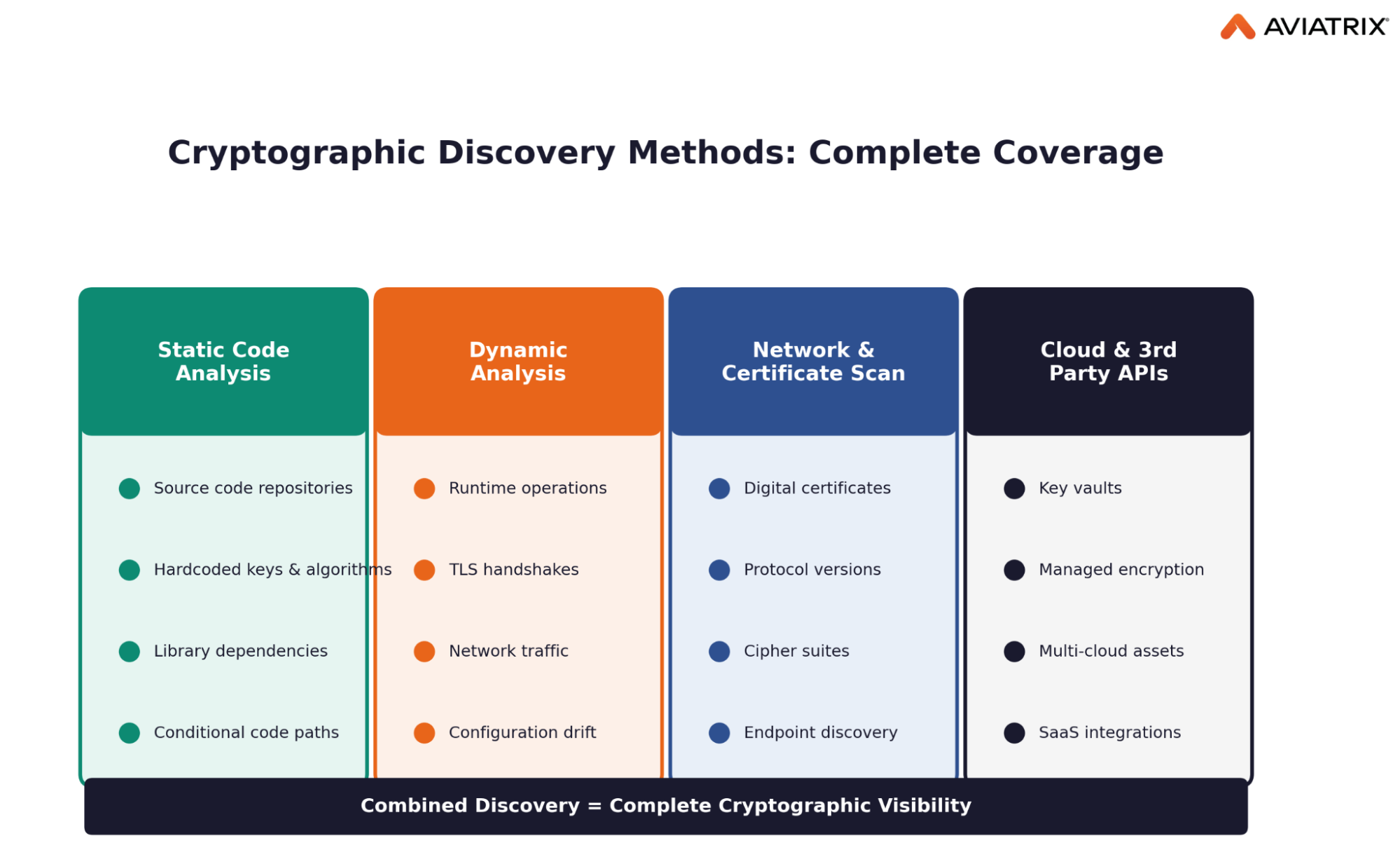
Cryptographic discovery uses multiple techniques to achieve complete visibility into your cryptographic infrastructure. No single tool covers everything. A truly comprehensive inventory requires layering discovery methods across code, runtime, network, and cloud environments. The goal is to capture every system that stores encrypted data or handles cryptographic operations including systems that perform cryptographic operations on behalf of other services.
Static Code Analysis Tools for Source Code Scanning
Static code analysis tools examine source code repositories to identify cryptographic usage patterns. Static code scanning finds hardcoded keys, identifies which algorithms your applications call, and maps cryptographic dependencies across your codebase.1
Static code analysis tools catch problems that runtime monitoring cannot see. They reveal cryptographic functions embedded in application logic, flag outdated algorithms developers may not realize they are using, and trace library dependencies through the software supply chain.
Static code scanning is particularly valuable for identifying cryptographic components that only activate under specific conditions. Code paths that handle key rotation, disaster recovery, or fallback encryption might never appear in runtime monitoring but are fully visible in source code analysis.
Dynamic Analysis for Runtime Cryptographic Operations
Dynamic analysis captures cryptographic operations as they happen in production. While static scanning looks at code, dynamic analysis watches your systems perform cryptographic operations in real time.3
Dynamic analysis monitors network traffic to identify cipher suites being negotiated, captures network communications to detect weak cryptographic configurations, and observes how cryptographic components behave under actual workloads.
This approach catches crypto usage from third-party services, runtime-configured parameters, and operations triggered only under specific conditions. Dynamic analysis is essential for environments where applications load configurations from external sources at runtime rather than embedding them in source code.
Runtime monitoring also reveals actual algorithms negotiated during TLS handshakes, which may differ from configurations. Protocol downgrade attacks become visible through dynamic analysis in ways static tools cannot detect.
Network Endpoint and Certificate Discovery
Scanning network endpoints reveals digital certificates, protocol configurations, and protocol versions across your infrastructure. This includes cloud workloads, on-premises servers, IoT devices, and hardware devices running cryptographic firmware.2
Certificate lifecycle management depends on knowing where every certificate lives. Discovery scanning identifies expired certificates before they cause outages and flags certificates using outdated algorithms or insufficient key lengths.
Certificate discovery also maps trust chains to issuing authorities, revealing dependencies that could impact your cryptographic infrastructure if compromised.
Cloud Services and Third-Party Integrations
Modern organizations run operations across dozens of cloud services. Each cloud provider manages its own key vaults, encryption services, and certificate stores. Your cryptographic inventory must extend into these environments to achieve a truly comprehensive view.4
Cloud workloads introduce unique challenges. Auto-scaling creates ephemeral instances, managed services abstract implementation details, and multi-cloud architectures fragment management across providers. Your cryptographic inventory needs API-driven discovery that queries cloud services directly because network scanning alone misses cloud-hosted assets.
Building a Comprehensive Cryptographic Inventory: Step-by-Step
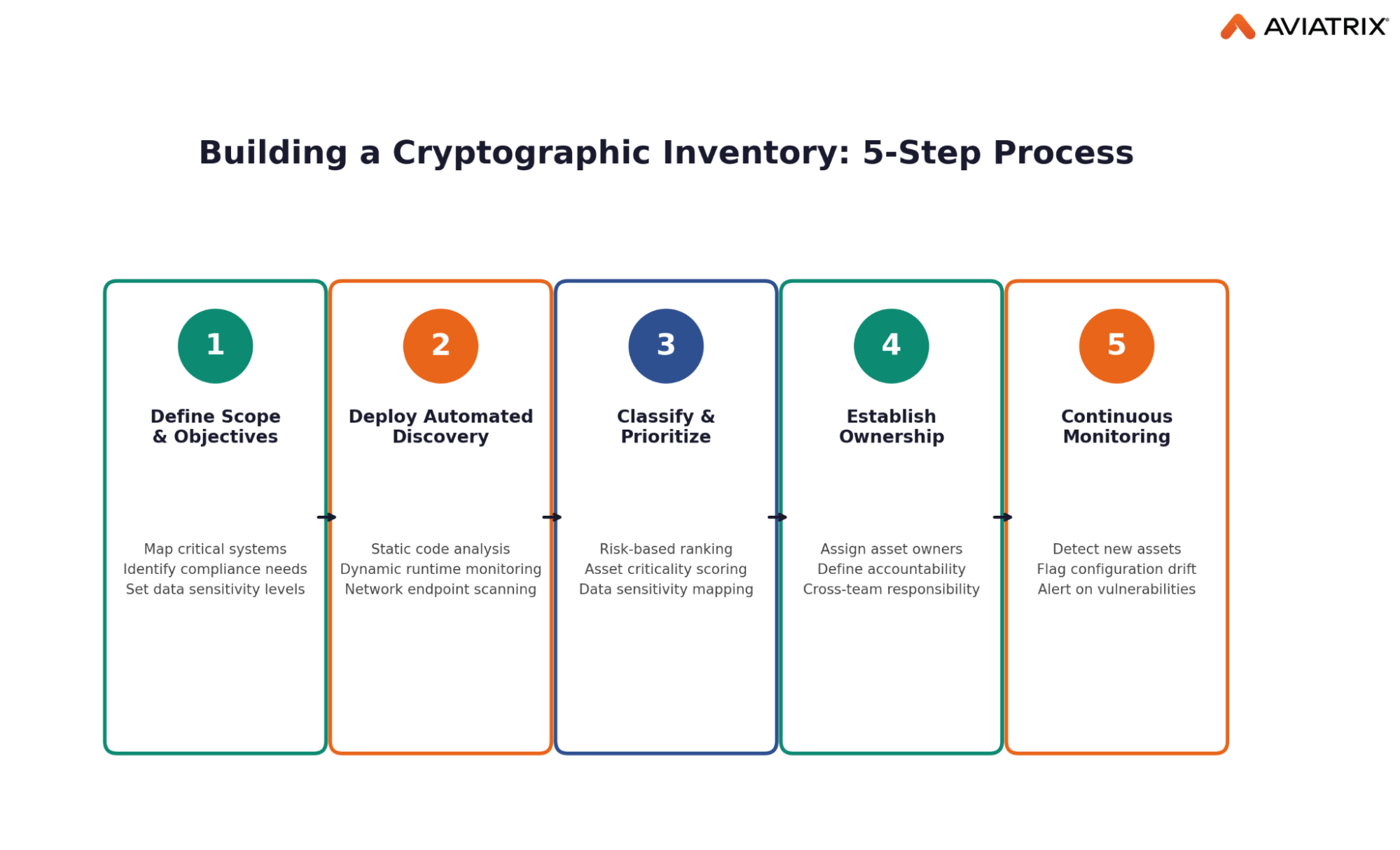
The inventory process requires a structured approach. Rushing into scanning without a plan produces raw discovery data that overwhelms security teams instead of empowering them.1
Step 1: Define Scope and Objectives
Start by defining what your cryptographic inventory needs to cover. Map your critical assets and critical systems. Identify the compliance requirements that apply to your organization. Determine the data sensitivity levels that drive cryptographic protection decisions.
Your scope should cover every environment where cryptographic operations occur: production systems, development environments, staging servers, cloud services, legacy systems, and partner integrations. Missing even one environment creates blind spots in your cryptographic inventory.
Step 2: Deploy Automated Discovery
Manual inventories fail at scale, making automated discovery non-negotiable. Deploy static code analysis tools to scan repositories, dynamic analysis tools to monitor runtime behavior, and network scanners to discover network endpoints and digital certificates.3
Effective cryptographic inventory management requires centralized tracking and continuous updates of cryptographic assets. Your discovery tools should feed into a centralized platform that normalizes raw discovery data into a consistent cryptographic asset inventory format. Without centralization, raw discovery data from different tools remains fragmented and difficult to act on.
The best automated discovery platforms combine results from multiple scanning techniques into a unified asset catalog that eliminates duplicates and cross-references findings. This transforms raw discovery data into actionable intelligence.
Step 3: Classify and Prioritize Cryptographic Assets
Not every cryptographic asset carries the same risk. A test certificate in a development environment is not the same as an RSA key protecting encrypted data containing financial records.
Risk prioritization should consider asset criticality, data sensitivity, algorithm strength, key age, and exposure surface. Your cryptographic inventory should make it easy to quickly identify affected assets when a new vulnerability drops or a cryptographic transition deadline approaches.2
Step 4: Establish Ownership and Accountability
Every significant cryptographic asset should have an accountable owner. Security teams alone cannot manage thousands of assets across an enterprise. Application teams, infrastructure teams, and security architects all share responsibility.1
Clear ownership ensures assets get updated when algorithms are deprecated, certificates get renewed before expiry, and configurations get hardened when known vulnerabilities emerge.
Assign ownership at the application, infrastructure, and key management levels. A single critical asset might have different owners for the certificate, the private key, and the application.
Step 5: Implement Continuous Monitoring
A cryptographic inventory that is not continuously updated is a cryptographic inventory that lies to you.
Continuous monitoring detects new assets as they appear, flags configuration drift, identifies expired certificates, and alerts on known vulnerabilities affecting your cryptographic libraries. The inventory process must be ongoing instead of a quarterly exercise.3
Continuous updates are necessary for maintaining an accurate cryptographic inventory. New applications deploy daily, certificates rotate, and libraries publish security patches. Your inventory must keep pace.
Cryptographic Asset Inventory Formats and Standards
A cryptographic asset inventory needs a consistent structure to be useful at scale. Without standardization, your cryptographic inventory becomes a collection of incompatible data sets from different tools and teams.2
What a Cryptographic Asset Inventory Should Capture
Every entry in your cryptographic asset inventory should include the asset type, the algorithm and key length, the owning application or service, the responsible team, the data sensitivity classification of what it protects, the current status, and the last validation date.
The cryptographic asset inventory should also track relationships between assets. A single TLS certificate may protect multiple network endpoints. A single library may serve dozens of applications. Understanding these dependencies is critical when planning cryptographic migrations or responding to vulnerabilities.4
Integrating the Cryptographic Asset Inventory with Existing Tools
Your inventory should integrate with your CMDB, vulnerability management platform, and certificate management tools. This integration eliminates data silos and enables security teams to correlate cryptographic risks with business context.
When a new CVE hits a library, your integrated systems should automatically flag every application in your cryptographic asset inventory that depends on the affected assets and escalate based on asset criticality.1
Cryptographic Bill of Materials: Documenting Cryptographic Dependencies
A cryptographic bill of materials (CBOM) extends the cryptographic inventory concept into the software supply chain. Just as a software bill of materials (SBOM) lists every software component, a cryptographic bill of materials catalogs every cryptographic dependency in your applications.4
The cryptographic bill of materials documents which cryptographic libraries each application uses, which algorithms those libraries implement, which keys and digital signatures the application relies on, and which configurations govern their behavior.
This level of documentation transforms your cryptographic inventory from a network-centric view into a full-stack comprehensive inventory that captures cryptographic usage at every layer. The cryptographic bill of materials reveals dependencies that network scanning and runtime monitoring cannot reach.
Organizations building cryptographic bill of materials documentation gain traceability from algorithm specification through library implementation to deployed application. That traceability is essential for cryptographic migrations where changing one library can cascade through dozens of dependent services.
Inventory Cryptography Across Legacy Systems
Inventory cryptography across legacy systems presents unique challenges. Older applications may use cryptographic functions that predate modern standards. Proprietary systems may lack APIs for automated discovery. Documentation may be incomplete or nonexistent.1
Inventory cryptography efforts in legacy systems often require a combination of approaches. Static code scanning works for systems with accessible source code. Dynamic analysis and network traffic inspection work for systems that can be observed externally. Manual review handles the rest.
Legacy systems frequently harbor the most dangerous cryptographic risks because they run the oldest algorithms and the most outdated protocols. They are often the last systems to get updated and the first systems that quantum computers will threaten.
The inventory should not store confidential key material but track metadata instead. For legacy systems, this means documenting algorithm types, key lengths, certificate authorities, and protocol versions without extracting actual keys.2
Inventory cryptography in legacy systems also means dealing with components that are no longer supported by their vendors. When a library reaches end-of-life, your cryptographic inventory should flag every system still depending on it so security teams can plan replacements.
Cryptographic Migrations: Planning the Transition to Post-Quantum
Cryptographic migrations depend entirely on the quality of your cryptographic inventory. You cannot plan a migration without knowing what needs to migrate.
A cryptographic inventory is essential for post-quantum migration planning. The inventory data tells you which algorithms are quantum-vulnerable, which critical systems use them, and what the remediation efforts will require.4
Prioritizing Cryptographic Migrations Based on Risk
Cryptographic migrations follow a risk-based approach. Your cryptographic inventory should enable you to:
Identify all cryptographic assets using classical algorithms vulnerable to quantum computers
Rank those affected assets by asset criticality and data sensitivity
Map dependencies between cryptographic components so you understand the blast radius of each change
Quickly identify affected assets when new quantum-resistant algorithms are standardized
Track migration progress across the entire cryptographic infrastructure2
Cryptographic inventories help manage risks associated with weak algorithms and expired certificates throughout the migration process. A maintained cryptographic inventory aids incident response during security breaches that may occur during the cryptographic transition.
The Cryptographic Transition Roadmap
The cryptographic transition to post-quantum algorithms follows a predictable path: inventory, assess, prioritize, migrate, and verify.
Your cryptographic inventory powers every step of that cryptographic transition. Without accurate inventory data, each phase becomes guesswork. With it, security architects can build realistic migration timelines tied to actual infrastructure rather than theoretical models.3
The cryptographic transition is a multi-year program that requires ongoing cryptographic inventory updates as new quantum-resistant algorithms are standardized and validated.
Crypto Agility Requires a Complete Inventory
Crypto agility is the ability to swap cryptographic components without rebuilding entire systems. Crypto agility enables rapid switching of cryptographic components when algorithms are compromised or deprecated.3
A comprehensive inventory is essential for achieving crypto agility. You cannot switch what you cannot find. Crypto agility is crucial for transitioning to post-quantum cryptography because the migration will not happen overnight, and organizations need the flexibility to update algorithms incrementally.
Crypto agility depends on knowing every point where cryptographic operations occur. Your cryptographic inventory provides that map. Without it, crypto agility remains a theoretical concept rather than an operational capability.
An inventory helps identify vulnerable cryptographic algorithms that need to be replaced first. Crypto agility built on top of a complete inventory lets organizations respond to new threats in days instead of months. Crypto agility transforms the cryptographic transition from a crisis response into a managed process.
Cryptographic Posture: Measuring and Improving Your Security
Your cryptographic posture is the overall health and security of your cryptographic infrastructure. A strong cryptographic posture means your organization uses current algorithms, manages certificates effectively, rotates keys appropriately, and maintains complete visibility into cryptographic usage.1
The cryptographic inventory is the foundation of cryptographic posture management. It provides the inventory data that security teams and security architects need to assess risk, track improvements, and demonstrate compliance to auditors.
Measuring Cryptographic Posture with Inventory Data
Cryptographic posture assessment uses inventory data to answer critical questions:
What percentage of cryptographic assets use quantum-resistant algorithms?
How many expired certificates exist across the infrastructure?
Which critical systems still depend on outdated algorithms?
Are keys being rotated according to policy?
Do all crypto libraries have current security patches applied?3
A strong cryptographic posture requires not just knowing what you have, but actively managing it through vulnerability management, risk assessment, and continuous improvement. Your cryptographic inventory makes that management possible by providing the data foundation everything else builds on.
Integrating with Vulnerability Management
Your cryptographic inventory should feed directly into your vulnerability management program. When a CVE drops against a cryptographic library, your inventory should let you quickly identify affected assets and prioritize patching based on risk prioritization scores.2
Vulnerability management for cryptographic assets requires the same rigor as application vulnerability management. Security teams need to track known vulnerabilities in crypto libraries, monitor for outdated protocols, and remediate findings based on asset criticality.
Risk Assessment and Remediation Efforts
Risk assessment for your cryptographic inventory considers multiple factors: the strength of the algorithm, the sensitivity of the data it protects, the exposure surface of the system, and the feasibility of migration.4
Your cryptographic inventory should support risk prioritization that helps security teams focus remediation efforts on the highest-risk assets first. Critical assets protecting sensitive data with vulnerable cryptographic keys get immediate attention.
Dynamic Analysis and Continuous Cryptographic Discovery
Dynamic analysis plays a critical role in maintaining an accurate cryptographic inventory over time. While initial discovery establishes the baseline, dynamic analysis ensures the inventory stays current as environments change.4
Dynamic analysis monitors network communications and network traffic to detect new cryptographic usage patterns, identifies cryptographic operations happening in cloud workloads, and catches configuration changes that static scanning would miss.
The combination of static code analysis tools and dynamic analysis provides the most accurate picture of your cryptographic infrastructure. Neither approach alone delivers complete visibility, but together they cover code-level and runtime crypto usage comprehensively.
Dynamic analysis also validates whether configurations match organizational policies. A server configured for TLS 1.3 may actually negotiate TLS 1.2 due to client compatibility settings.
Cryptographic Inventory for Incident Response and Breach Management
A maintained cryptographic inventory aids incident response during security breaches. When an attacker compromises a library or steals keys, your cryptographic inventory tells the response team exactly what is at risk.1
Without a cryptographic inventory, incident response teams spend critical hours manually discovering which systems use the compromised component. With one, they can quickly identify affected assets within minutes and begin containment immediately.
Your cryptographic inventory should integrate with your incident response playbooks. When a breach involves cryptographic components, the playbook should reference the cryptographic inventory to identify affected assets, assess data sensitivity of exposed information, and determine which keys need emergency rotation.3
Security teams that maintain current inventories respond to incidents faster and scope breaches more accurately.
Certificate Lifecycle Management and Outage Prevention
Certificate lifecycle management is one of the most immediately practical benefits of a cryptographic inventory. Expired certificates cause outages. Outages cost money and erode trust.
Your cryptographic inventory should track every digital certificate across your infrastructure, including expiration dates, issuing authorities, key algorithms, and key lengths. Automated alerting should notify certificate owners well before expiration so renewals happen on schedule.2
Certificate lifecycle management also covers certificate rotation, revocation, and reissuance. When a certificate authority is compromised, your cryptographic inventory reveals every certificate in your infrastructure that chains to that authority, allowing you to plan reissuance before trust is lost.
Organizations that manage certificate lifecycle management through their cryptographic inventory experience fewer outages and better compliance posture.
Common Mistakes in Cryptographic Inventory Management
Many organizations make the following mistakes when building their cryptographic inventory:
Treating it as a one-time project. A cryptographic inventory requires continuous monitoring and updates. Organizations that inventory once and never revisit quickly lose accuracy as their cryptographic infrastructure evolves.1
Ignoring crypto libraries in dependencies. Applications may use libraries indirectly through frameworks and third-party packages. Cryptographic dependencies buried deep in your dependency tree are still your responsibility.
Focusing only on network endpoints. A complete inventory covers source code, configurations, key stores, key vaults, hardware devices, cloud services, and application logic. Scanning only network endpoints misses the majority of cryptographic assets.
Storing actual key material in the inventory. The inventory should not store confidential key material but track metadata instead. Copying actual keys into an inventory database creates a new attack surface.3
Skipping legacy systems. Legacy systems harbor the most dangerous cryptographic risks and the hardest assets to discover. Excluding them creates blind spots where you can least afford them.
Ignoring cryptography usage in DevOps pipelines. CI/CD pipelines, container images, and infrastructure-as-code templates all contain cryptographic configurations and cryptographic dependencies that belong in your cryptographic inventory. Cryptography usage in DevOps often flies under the radar because it sits outside traditional security scanning.
The Role of Security Architects in Cryptographic Inventory Programs
Security architects play a central role in designing and governing the cryptographic inventory program. They define the standards that determine which algorithms are approved, which configurations are acceptable, and which compliance requirements the organization must meet.1
Security architects also design integration points between the cryptographic inventory and other security tools, connecting it to vulnerability management platforms, SIEM systems, and compliance reporting dashboards.
The best cryptographic inventory programs give security architects dashboards showing cryptographic posture trends over time. Are outdated algorithms decreasing? Is the percentage of quantum-resistant algorithms increasing? These trend lines tell security architects whether their strategies are working.4
Sources
NIST, "Migration to Post-Quantum Cryptography," https://csrc.nist.gov/projects/post-quantum-cryptography
CISA, "Post-Quantum Cryptography Initiative," https://www.cisa.gov/quantum
NSA, "Cybersecurity Advisory: Quantum-Readiness," https://www.nsa.gov/Cybersecurity/Post-Quantum-Cybersecurity-Resources/
NIST, "Post-Quantum Cryptography Standardization," https://csrc.nist.gov/projects/post-quantum-cryptography/post-quantum-cryptography-standardization
European Commission, "NIS2 Directive," https://digital-strategy.ec.europa.eu/en/policies/nis2-directive

