
Every encrypted connection you make today relies on a key exchange. Two systems agree on a shared secret key, and that key protects everything that follows.
The problem is that the algorithms powering most key exchange today will break when a sufficiently powerful quantum computer arrives. RSA and elliptic curve cryptography depend on integer factorization and discrete logarithms. Quantum algorithms solve both efficiently.
FIPS 203 is the answer. Finalized on August 13, 2024, FIPS 203 is the first post-quantum cryptography standard approved by NIST. It standardizes the ML-KEM key encapsulation mechanism, a lattice-based key encapsulation scheme designed to resist future attacks from quantum computers while running on existing network infrastructure.1
The standard is now mandatory for federal agencies building new national security systems. And every organization handling sensitive data should be paying attention.
What Is FIPS 203?
FIPS 203 stands for Federal Information Processing Standards Publication 203. It is the ML-KEM standard published by the National Institute of Standards and Technology (NIST) as part of the PQC standardization process.2
The standard specifies a key encapsulation mechanism called ML-KEM (also written ML KEM), which stands for Module-Lattice-Based Key Encapsulation Mechanism. A key encapsulation mechanism lets two parties establish a shared secret key over a public channel without an attacker being able to recover that secret key.1
The standard was finalized on August 13, 2024, alongside FIPS 204 (ML DSA for digital signatures) and FIPS 205 (SLH-DSA for hash-based digital signature schemes). Together, these three algorithms form the foundation of NIST's post-quantum cryptography initiative.
The ML-KEM standard in FIPS 203 gives organizations a validated path to quantum-resistant key establishment. It is part of NIST's initiative for post-quantum cryptography standardization, and it is designed to protect against potential future threats posed by quantum computers against legacy cryptography.2
How the ML-KEM Key Encapsulation Mechanism Works
A key encapsulation mechanism is different from traditional key exchange protocols like Diffie-Hellman. Instead of both parties contributing to the shared secret, one party generates it and encapsulates it for the other.
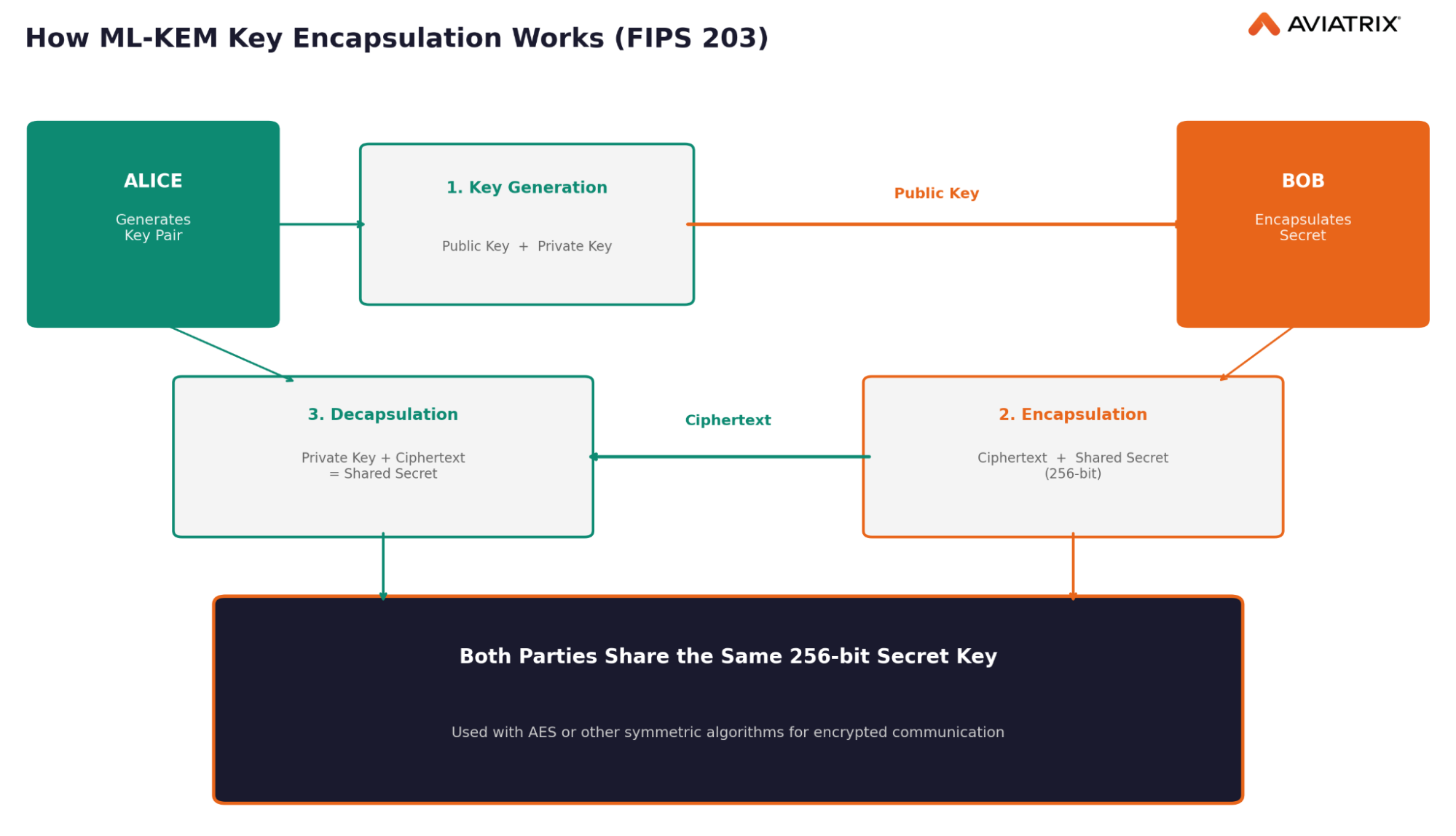
ML-KEM defines three operations.1
Key Generation for ML-KEM
Key generation creates an encapsulation key (the public key) and a decapsulation key (the private key). The keys generated during this step use the algebraic structure of module lattice-based problems to ensure security properties that hold against both classical and quantum attacks.
Key generation in FIPS 203 includes domain separation to prevent cross-protocol attacks. This means the keys generated for one ML-KEM parameter set cannot be confused with keys from another set or from a different cryptographic scheme.3
Encapsulation: Creating the Shared Secret Key
The sender uses the recipient's public key to produce two outputs: a ciphertext and a shared secret key. The shared secret key is fixed at 256 bits across all ML-KEM parameter sets, regardless of which set is used.1
The ciphertext can travel over any public channel. An attacker who intercepts it cannot recover the shared secret key without the corresponding private key.
Decapsulation: Recovering the Shared Secret Key
The recipient uses their private key to recover the shared secret key from the ciphertext. FIPS 203 includes implicit rejection, meaning that if decapsulation fails due to a tampered ciphertext, the mechanism returns a pseudorandom value instead of an error. This prevents attackers from learning anything about the private key through decapsulation failures.3
The recovered shared secret key is then used with symmetric key cryptographic algorithms like AES to encrypt the actual communication. The key encapsulation mechanism handles the hard part of establishing the shared secret securely. The symmetric key does the heavy lifting of bulk encryption.
FIPS 203 ML KEM Parameter Sets: Security Levels and Trade-offs
FIPS 203 defines three ML-KEM parameter sets: ML-KEM-512, ML-KEM-768, and ML-KEM-1024, in order of increasing security strength and decreasing performance.1
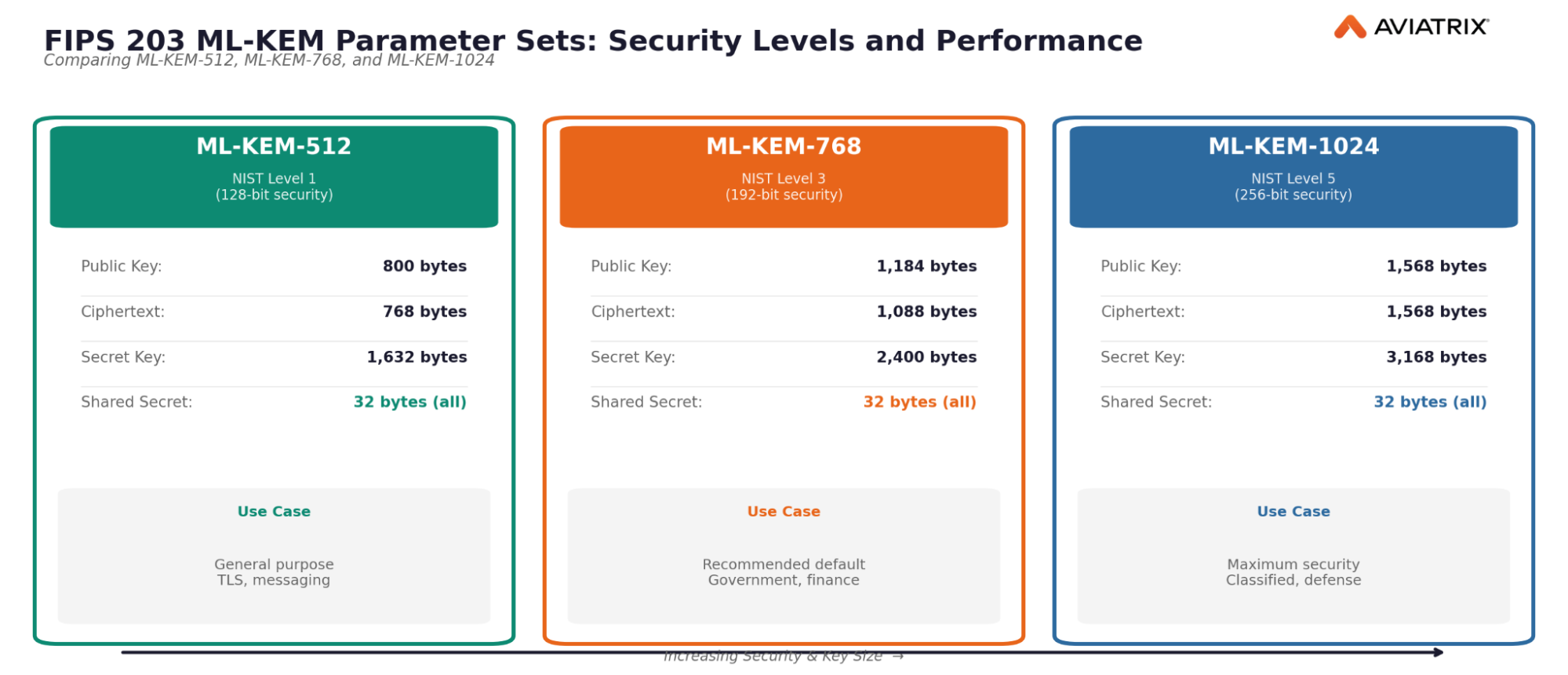
Each parameter set impacts key and ciphertext sizes during encryption.
ML-KEM-512: Baseline Security
ML-KEM-512 offers baseline security equivalent to 128-bit classical security. It provides the smallest key and ciphertext sizes, making it suitable for constrained environments where bandwidth and storage matter most.2
ML-KEM-768: The Recommended Default
ML-KEM-768 is frequently recommended as a robust baseline equivalent to AES-192. It provides enhanced security suitable for most sensitive applications and is the recommended default for civilian federal agencies and enterprise deployments.4
ML-KEM-768 balances security level and performance, making it the right choice for organizations that want strong protection without the overhead of ML-KEM-1024.
ML-KEM-1024: Maximum Assurance
ML-KEM-1024 is recommended for high assurance environments. It delivers the highest security level equivalent to 256-bit classical security and is required for national security systems under CNSA 2.0 guidelines.1
The trade-off is larger keys and ciphertexts. ML-KEM-1024 produces a 1,568-byte public key compared to 800 bytes for ML-KEM-512. For most applications, ML-KEM-768 provides sufficient margin.
Choose the appropriate ML-KEM parameter set based on your security requirements and performance constraints.
Lattice-Based Key Encapsulation: Why ML-KEM Uses Lattices
ML-KEM is a lattice-based key encapsulation mechanism. Its security rests on the Module Learning with Errors problem, a mathematical challenge that remains hard even for quantum computers.3
The Module Learning with Errors Problem
The errors problem at the heart of ML-KEM works like this: given a system of linear equations with small random errors added, recovering the original solution is computationally infeasible. The module lattice variant structures this problem using polynomial multiplication over rings, which keeps keys and ciphertexts relatively compact.1
This algebraic structure is what separates lattice-based cryptography from older systems. RSA and elliptic curve cryptography rely on integer factorization and discrete logarithms, problems that quantum algorithms solve efficiently. Module lattice-based key problems have no known efficient quantum attacks.
ML-KEM is based on lattice problems, unlike RSA and ECC. This makes it a fundamentally different cryptographic scheme with different security properties.2
FIPS 203 and the Based Key Encapsulation Mechanism Standard
FIPS 203 is the key encapsulation mechanism standard that defines how the ML-KEM scheme must be implemented for government use. It is a complete specification with input validation, approved usage guidelines, and specific implementation details.1
The standard requires FIPS 140-3 validated modules. Any organization deploying the mechanism for federal work must use a cryptographic module validated under the Cryptographic Module Validation Program.4
FIPS 203 requires the use of cryptographically strong random values for its operation. Weak randomness undermines the entire key encapsulation mechanism, regardless of which parameter sets are selected.
The standard also defines approved usage for each parameter set, key generation procedures, and test requirements that accredited laboratories evaluate during validation. Implementation must adhere to FIPS 203 specifications for security.3
Implementing ML KEM on Existing Network Infrastructure
One of the practical considerations for implementing ML KEM is that the ML KEM scheme requires larger keys than RSA or ECC for equivalent security. An ML-KEM-768 public key is 1,184 bytes versus 32 bytes for X25519.2
This impacts existing infrastructure. TLS handshakes, VPN tunnels, and certificate chains all carry these larger keys. Organizations need to evaluate whether their existing network infrastructure can handle the increased payload sizes without fragmentation or timeout issues.
To effectively implement ML-KEM, plan for these changes.
Bandwidth: Larger keys and ciphertexts increase handshake sizes. Test your network paths for MTU issues.
Storage: Decapsulation keys are significantly larger. ML-KEM-1024 requires 3,168 bytes for the private key alone.
Performance: Key generation and encapsulation are fast, but decreasing performance at higher security levels means benchmarking is essential.
Compatibility: Not all endpoints support FIPS 203 yet. Plan for mixed environments during transition.
FIPS 203 facilitates interoperability across diverse IT and security systems. The standard is designed so that cryptographic technology vendors can build compatible implementations that work across platforms.4
Hybrid Cryptography: Combining ML-KEM with Classical Key Exchange
Hybrid cryptography is the recommended migration strategy. Instead of replacing classical key exchange entirely, organizations combine ML-KEM with established algorithms like X25519 or P-384.5
Hybrid key establishment combines classical and ML-KEM algorithms so that the connection remains secure as long as either algorithm holds. If ML-KEM turns out to have an unforeseen weakness, the classical component still protects the shared secret key. If quantum computing breaks the classical component, ML-KEM provides the defense.
The IETF has defined hybrid groups for TLS 1.3, including X25519MLKEM768 and SecP384r1MLKEM1024. These key establishment scheme options let organizations deploy post quantum protection on existing network infrastructure without abandoning proven classical algorithms.5
Hybrid cryptography is a practical considerations bridge. It gives the industry time to build confidence in lattice-based cryptography while maintaining backward compatibility.
The ML KEM Standard vs. Previous Schemes and Classical Key Exchange
FIPS 203 represents significant advancements over previous schemes for key exchange.
Classical Diffie-Hellman and ECDH produce shared secret keys through a mutual exchange. A key encapsulation mechanism uses a different model: one party encapsulates, the other decapsulates. This asymmetry simplifies protocol design and reduces round trips.
ML-KEM achieves security against quantum attacks, unlike RSA and ECC. The final version of FIPS 203 incorporated changes from the PQC standardization process, including fixing the shared secret key length at 256 bits and adding domain separation to key generation.3
Compared with previous schemes like CRYSTALS-Kyber (the submission name), the ML-KEM standard in FIPS 203 adds input validation, implicit rejection, and stricter requirements for random number generation. These are more than cosmetic changes; they address real attack vectors discovered during the PQC standardization process.1
Data Protection Strategies with FIPS 203
The standard aims to secure data against quantum computing threats. Applications include secure communications, protecting cloud data, and safeguarding national security systems.2
Data protection strategies should incorporate FIPS 203 as part of a layered defense.
Secure communications: Use ML-KEM for TLS key exchange to protect data in transit against potential future threats.
Cloud security: Deploy FIPS 203 validated encryption modules for key establishment in cloud environments.
Long-term secrets: Any data that must remain confidential for decades needs post-quantum protection now. Harvest Now, Decrypt Later attacks make this urgent.
FIPS standards are used widely across U.S. government systems and contractors. The standard extends that trust to post-quantum cryptography, giving federal agencies and regulated industries a validated path to quantum-resistant data protection strategies.4
The based key encapsulation mechanism in FIPS 203 provides the key establishment primitive. Combined with symmetric key cryptographic algorithms and digital signatures from ML-DSA, organizations get a complete post-quantum cryptographic toolkit.
ML KEM and ML DSA: The Federal Information Processing Standards Ecosystem
The standard does not operate in isolation. The ML KEM scheme handles key encapsulation. ML DSA (FIPS 204) handles digital signatures. Together they cover the two fundamental public key cryptosystems operations: confidentiality and authentication.1
Digital signature schemes based on ML DSA ensure that the party you are establishing keys with is who they claim to be. Without authenticated key establishment, an attacker could substitute their own public key and intercept the shared secret key.
Both standards use lattice-based cryptography, which means organizations migrating to post-quantum standards can build expertise in one mathematical family. The cryptographic algorithms share similar practical considerations for key sizes and performance.
Practical Considerations for Federal Agencies
Federal agencies face specific compliance requirements when adopting FIPS 203.
The standard must meet validation requirements under the Cryptographic Module Validation Program. Every cryptographic module deploying the ML KEM scheme needs a FIPS 140-3 certificate. The based key encapsulation mechanism implementation must pass CAVP algorithm testing before the module can be validated.4
Hash functions used within ML KEM must also be FIPS-approved. The standard uses SHA-3 variants internally, and these must come from validated implementations.
Federal agencies should evaluate their security requirements, select the appropriate ML KEM parameter sets, and begin procurement of validated cryptographic products. The private key pair management infrastructure must be updated to handle the larger key sizes that lattice-based key encapsulation requires.
Symmetric key cryptographic algorithms used alongside the ML KEM standard for bulk encryption must also meet FIPS validation requirements. The shared secret key produced by the mechanism feeds into AES or similar approved ciphers for the actual data protection.
Sources
NIST, "FIPS 203: Module-Lattice-Based Key-Encapsulation Mechanism Standard," https://csrc.nist.gov/pubs/fips/203/final
NIST, "Post-Quantum Cryptography Standardization," https://csrc.nist.gov/projects/post-quantum-cryptography
IETF, "ML-KEM Security Considerations," https://www.ietf.org/archive/id/draft-sfluhrer-cfrg-ml-kem-security-considerations-02.html
NIST, "Cryptographic Module Validation Program," https://csrc.nist.gov/projects/cryptographic-module-validation-program
IETF, "X25519MLKEM768 Hybrid Key Exchange in TLS 1.3," https://datatracker.ietf.org/doc/draft-ietf-tls-ecdhe-mlkem/

