
Every secure connection on the internet depends on TLS.
Every time you see HTTPS in your browser, TLS is working behind the scenes. It protects your credentials, your data, and your transactions from anyone watching the network path between you and the servers you connect to.1
But here is the problem: traditional TLS relies on RSA and elliptic curve cryptography for key exchange and authentication. These algorithms are mathematically sound today, but a cryptographically relevant quantum computer changes everything.
Post-quantum TLS answers that problem. This article explains how post-quantum TLS upgrades the standard TLS protocol to resist attacks from quantum computers, why the transition matters now, and what security teams need to do about it.2
What Is Post-Quantum TLS?
Post-quantum TLS is an upgraded version of the standard TLS protocol that replaces vulnerable asymmetric algorithms with post-quantum cryptography standards.1 It is designed to protect data from both classical attackers and future quantum computers.
Traditional TLS uses classical asymmetric algorithms for key exchange. RSA and classical curves both rely on mathematical problems that a sufficiently advanced quantum computer can break.
Post-quantum TLS swaps these vulnerable components for quantum-safe alternatives.
The NIST has standardized post-quantum cryptography algorithms specifically for this purpose. ML-KEM handles key establishment. ML-DSA and SLH-DSA handle digital signatures and authentication.3
These algorithms are built on mathematical problems that quantum computers cannot efficiently solve.
Post-quantum TLS is not a new protocol. It is the same TLS 1.3 structure you already use, with stronger cryptography inside.
The handshake still happens, and the encryption still protects the data. The difference is that the key exchange and authentication mechanism can withstand quantum computing attacks.
This distinction matters. TLS 1.3 does not automatically provide post-quantum protection; organizations must actively deploy post-quantum TLS configurations to gain quantum-safe security.2
How Post-Quantum Cryptography Strengthens TLS
Post-quantum standards replace the mathematical foundations that quantum computers can exploit. Classical methods rely on the difficulty of factoring large numbers or solving discrete logarithm problems. These problems are easy for quantum computers running Shor's algorithm.
Post-quantum cryptography uses entirely different mathematical structures. Lattice-based problems, hash-based constructions, and code-based systems form the new foundation.3
These algorithms carry the same role inside TLS. They establish shared secrets during the handshake, sign certificates for authentication, and protect encryption keys that guard session data.
No known quantum algorithm can efficiently solve the underlying math. That is what makes post-quantum TLS resistant to both classical and quantum attacks.
Why Traditional TLS Is Vulnerable to Quantum Computers
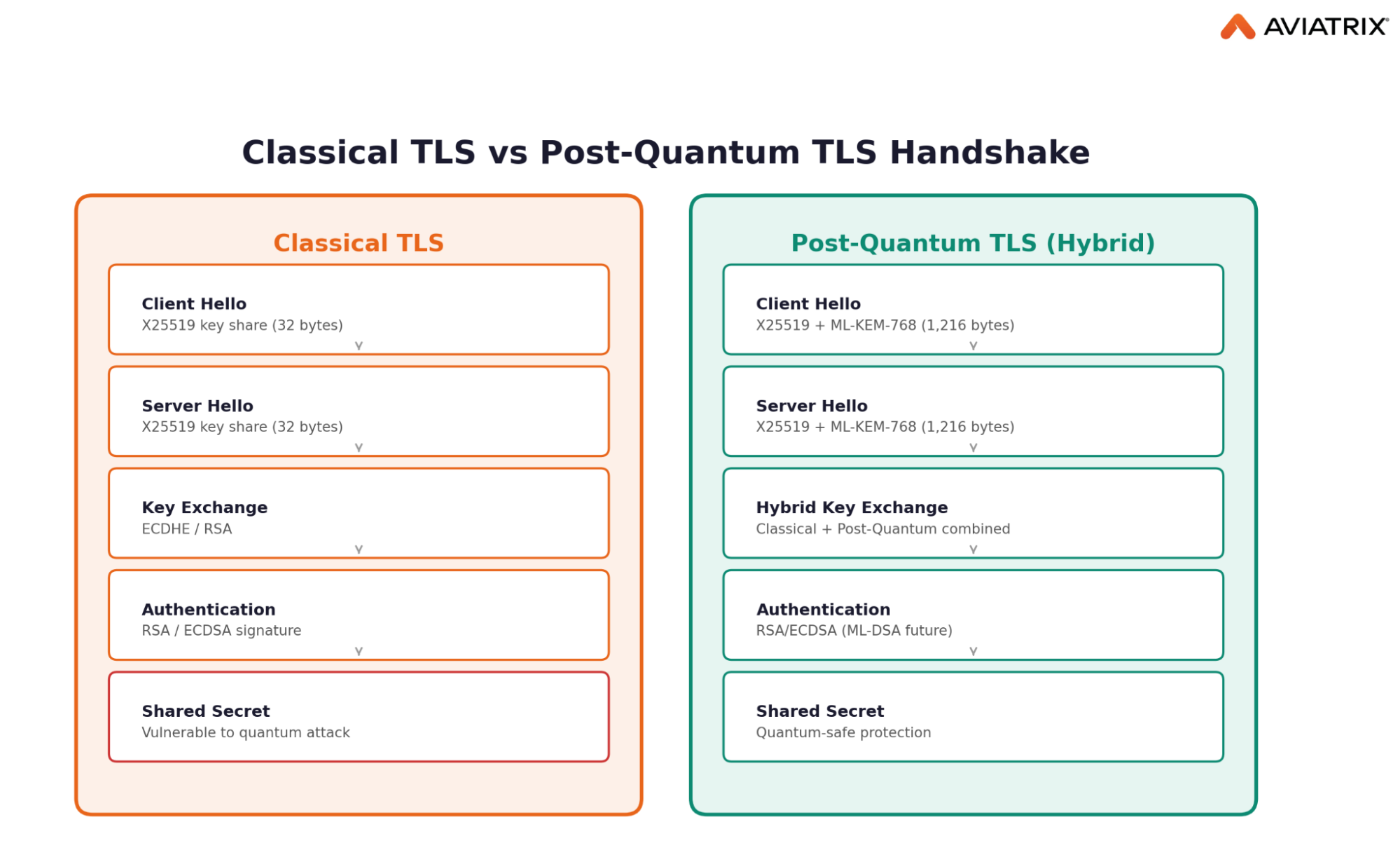
Traditional TLS relies on the difficulty of factoring large numbers (RSA) or solving discrete logarithm problems. Classical computers cannot solve these at scale, but quantum computers can.1
A sufficiently advanced quantum computer can mathematically break these foundations using Shor's algorithm. Every key exchange, every authentication step, and every secure channel built on RSA or classical curves becomes visible to an attacker with a cryptographically relevant quantum computer.1
The risk is happening right now through Harvest Now, Decrypt Later attacks. Adversaries capture encrypted data traveling across the network path today, store it, and wait for quantum computing to mature. Once a capable machine arrives, all that stored data becomes readable.
This Decrypt Later risk threatens any information that must remain confidential for years.
Government communications, healthcare records, financial transactions, intellectual property. If it needs long-term confidentiality, it needs post-quantum TLS today.4
The Role of Key Exchange in Post-Quantum TLS
Key exchange is the most urgent component to upgrade.
During a TLS handshake, the client and server perform a key exchange to establish a shared secret. That shared secret encryption protects everything that follows in the session.
If an attacker records the key exchange today and later breaks the underlying math with a quantum computer, they can decrypt the entire session: every message, credential, and file.2 That is why post-quantum TLS prioritizes key exchange upgrades over signature upgrades; key exchange protects data confidentiality.
Signature algorithms protect authentication and integrity, which matter at the moment of connection, not years later.
Post-quantum key exchange uses algorithms like ML-KEM, which is based on lattice cryptography and Module Learning with Errors. These algorithms produce larger public keys and ciphertext sizes, but they prove resistant to quantum computing attacks.3
Post-quantum TLS requires larger public keys and ciphertext sizes. The exchange value for X25519MLKEM768 is 1,216 bytes per the IETF draft, significantly larger than the 32 bytes used by classical X25519.
What Is Hybrid Key Exchange?
Hybrid key exchange combines classical and post-quantum key exchange mechanisms into a single operation.3
Instead of relying on just one algorithm, the hybrid approach layers two together.
The most widely deployed hybrid combination is X25519MLKEM768. It combines X25519 (which uses elliptic curve Diffie-Hellman) with ML-KEM-768 for security.
Both algorithms run during the TLS handshake. Both contribute to the final shared secret.
Hybrid key exchange addresses the Harvest Now, Decrypt Later risk by ensuring that even if one algorithm is broken, the other still protects the session.2
Hybrid security layering can ensure protection even if one component fails, keeping failure rates low. This approach allows for maintaining compatibility with existing security infrastructure. Hybrid key exchange does not require new SSL certificates. Your existing certificate infrastructure, certificate authorities, and deployment processes stay the same.
How Hybrid TLS Works in Practice
Hybrid TLS combines classical and post-quantum mechanisms during the TLS handshake.1
The client sends both a classical and a post-quantum share. The server responds with both. The final shared secret is derived from both results.
Hybrid TLS does not require new SSL certificates for implementation. The authentication side of the handshake stays unchanged. Only the key exchange component gets the post-quantum upgrade. This makes hybrid TLS the fastest path to post-quantum TLS deployment.
Hybrid TLS handshake size is 1,216 bytes for X25519MLKEM768. Larger handshakes can affect network infrastructure performance.3
Firewalls, load balancers, and middleboxes that inspect TLS traffic may need configuration updates to handle the larger messages.
Servers and clients must both support the hybrid group for post-quantum TLS to activate. If either side does not support it, the TLS handshake falls back to classical key exchange by default. This compatibility ensures that enabling post-quantum TLS does not break existing connections.
Performance and Infrastructure Impact of Post-Quantum TLS
Post-quantum TLS may increase CPU, latency, and connection establishment time.2
The performance impact varies based on workload and connection type. Short-lived connections see more overhead because the handshake represents a larger percentage of total session time.
Testing is essential to measure production-like performance impacts.
Security teams should be evaluating post-quantum TLS in staging environments before rolling it out to production endpoints. Real-world latency depends on network path characteristics, middlebox behavior, and server software configurations.
Larger handshakes can affect firewalls and network appliances.4
Some older infrastructure may reject or truncate larger messages. Organizations should test from clients through firewalls to servers.
The benefits outweigh the costs. A small increase in handshake latency is a minor price for protecting data against quantum computing attacks that threaten long-term confidentiality. The challenge is how to deploy post-quantum TLS without disrupting existing services.
Quantum Computing and the Migration Timeline
Quantum computing advances are accelerating.1 While a capable quantum machine does not exist today, the planning must start now. Transitioning the entire internet to post-quantum TLS cannot happen overnight.
Organizations are encouraged to begin migrating to post-quantum standards now. The migration to post-quantum TLS requires updating global software libraries and compatibility efforts across every layer of the network stack.
Quantum computing research is progressing steadily. Organizations that wait for a quantum machine to actually break classical cryptography will be too late.4 The Harvest Now, Decrypt Later risk means data captured today is already at risk if it needs long-term confidentiality.
Organizations should start post-quantum migration before quantum computers arrive. The response must be proactive, not reactive. Every month of delay means more data exposed to future decryption.
Post Quantum Migration: Planning the Transition
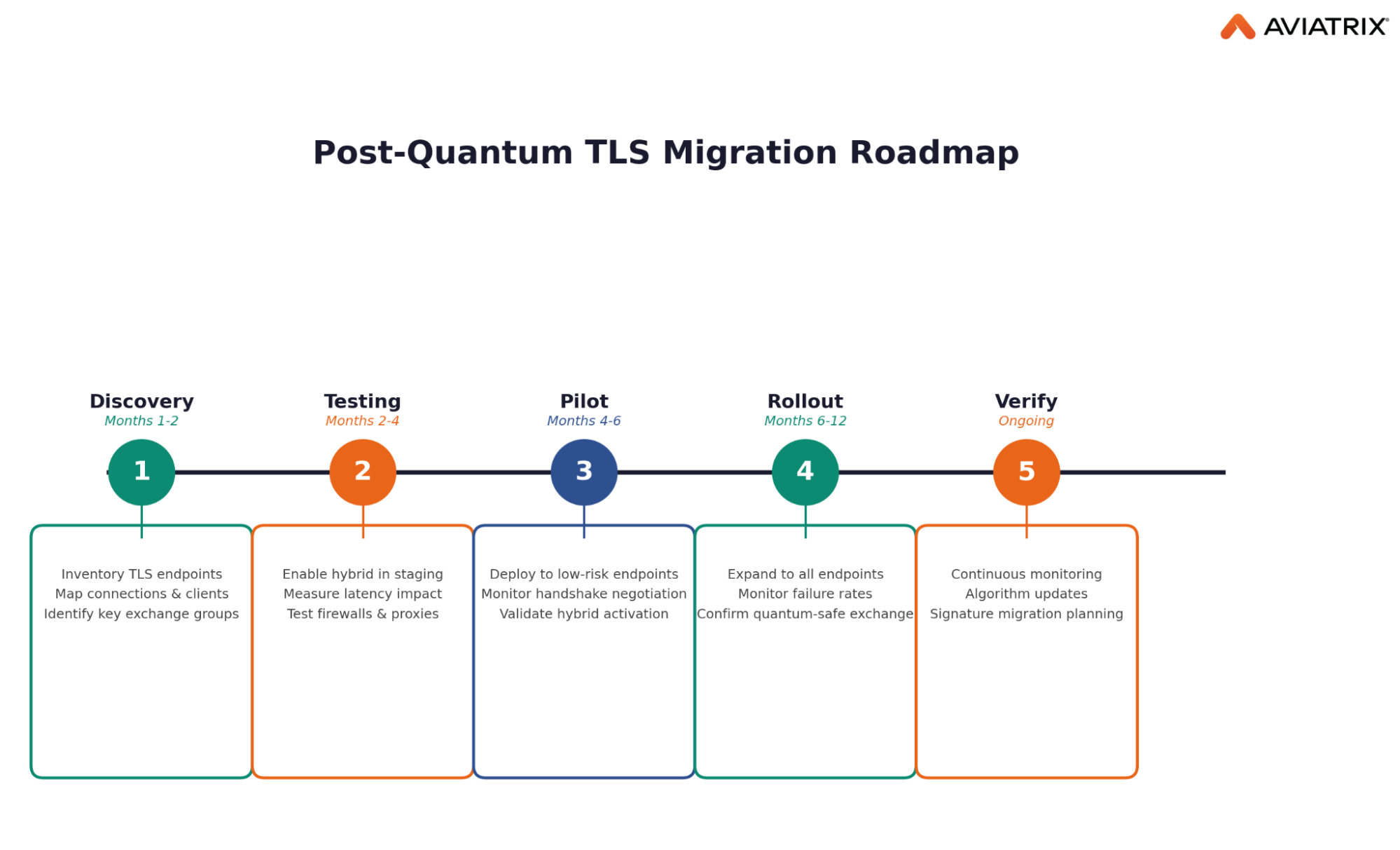
Post quantum migration requires a structured planning process.2 Security teams need to inventory their TLS endpoints, identify which connections support post-quantum TLS, and build a phased rollout plan.
Quantum migration starts with understanding your current TLS environment. Which servers support TLS 1.3? Which clients support hybrid key exchange groups? Which network appliances sit in the path and could affect larger handshakes?
Post-quantum migration requires testing actual negotiated groups. Just enabling post-quantum TLS on a server does not guarantee clients will negotiate it.3
Security teams must verify that hybrid key exchange is actually being used in production by monitoring TLS handshake parameters.
Quantum migration is not a single event. It is a phased transition that touches servers, clients, firewalls, load balancers, CDNs, and every piece of infrastructure in the network path. The ability to manage this transition smoothly depends on thorough planning and testing.
Quantum Cryptography vs Post-Quantum TLS
Quantum cryptography and post-quantum TLS are fundamentally different approaches to security. The distinction matters because organizations sometimes confuse them.
Quantum cryptography uses the properties of quantum physics to distribute keys.5 Quantum Key Distribution (QKD) requires specialized hardware, fiber optic connections, and has distance limitations. It is not a software upgrade.
Post-quantum TLS is a software upgrade. It uses mathematical algorithms that resist quantum computing attacks, deployed through standard TLS infrastructure. It doesn’t require quantum hardware or special network architecture.
Quantum cryptography protects against eavesdropping by making interception detectable. Post-quantum cryptography protects against future quantum computers by using harder math.
For most organizations, post-quantum TLS is the practical path forward.
Crypto Agility and Post-Quantum TLS
Crypto agility is the ability to swap cryptography components without rebuilding systems.3
Post-quantum TLS depends on crypto agility because the post-quantum algorithms are relatively new and could evolve.
Careful implementation of new algorithms is essential to prevent vulnerabilities. If a post-quantum algorithm has a weakness, crypto agility lets organizations fix the issue by swapping in a replacement without redesigning their TLS architecture.2
Crypto agility also supports the transition from hybrid key exchange to pure post-quantum key exchange in the future.
Today, hybrid TLS provides a safety net. Eventually, the classical component may become unnecessary. Crypto agility makes that transition seamless. Organizations building post-quantum TLS deployments should design for crypto agility from the start.
Code that hardcodes specific algorithm identifiers will need rewriting when standards evolve. Code that abstracts the algorithm choice behind a configuration layer adapts automatically.
Quantum-Safe Algorithms for TLS: ML DSA and Beyond
Quantum-safe algorithms for TLS fall into two categories: key establishment and digital signatures.
For key establishment, ML-KEM is the primary standard. It handles the key exchange portion of the TLS handshake, ensuring that session keys remain confidential against quantum computers.3
For digital signatures, ML DSA provides the primary authentication mechanism. ML-DSA replaces RSA and ECDSA signatures in TLS certificates and handshake authentication.
SLH-DSA serves as a conservative backup based on hash functions rather than lattices.
Post-quantum TLS enhances the integrity of secure channels and digital certificates. Combining quantum-safe key exchange with quantum-safe signatures creates a complete deployment where both confidentiality and authentication resist quantum computing attacks.
Implementing post-quantum TLS requires evaluating which algorithms your TLS software supports.5
Major libraries including OpenSSL, BoringSSL, and AWS-LC already support hybrid key exchange with X25519MLKEM768. Signature migration to ML DSA is progressing but requires new certificates.
Deploying Post-Quantum TLS at Scale
Deploying post-quantum TLS at scale requires coordination across infrastructure teams, application teams, and security teams.4
The challenge is not enabling a single server but ensuring post-quantum TLS works across every endpoint in your environment.
Start with high-value endpoints that carry sensitive data. APIs handling credentials, payment processing connections, and internal services transmitting proprietary data should get post-quantum TLS first.
Lower-risk endpoints follow on a planned schedule.
Monitor TLS handshake negotiation to confirm that hybrid key exchange is actually being selected. Some clients may fall back to classical key exchange by default.
Continuous monitoring ensures your post-quantum TLS deployment delivers the protection you expect.
Post-quantum TLS protects against attacks from future quantum computers. Organizations that deploy now gain the benefits of quantum-safe protection while avoiding the scramble when quantum computing reaches the threshold to break classical algorithms.1
Sources
NIST, "Post-Quantum Cryptography Standardization," https://csrc.nist.gov/projects/post-quantum-cryptography/post-quantum-cryptography-standardization
CISA, "Post-Quantum Cryptography Initiative," https://www.cisa.gov/quantum
IETF, "Hybrid Key Exchange in TLS 1.3," https://datatracker.ietf.org/doc/draft-ietf-tls-hybrid-design/
NSA, "Cybersecurity Advisory: Quantum-Readiness," https://www.nsa.gov/Cybersecurity/Post-Quantum-Cybersecurity-Resources/
NIST, "Migration to Post-Quantum Cryptography," https://csrc.nist.gov/projects/post-quantum-cryptography

