
Azure Firewall is a cornerstone of modern cloud network security, acting as a safeguard for Azure Virtual Network resources. It represents a fully stateful, cloud native firewall service, ensuring high availability without the need for additional configurations or load balancers. Azure Firewall’s design allows it to scale automatically, adapting to fluctuating network traffic and ensuring that your security posture is never compromised by traffic peaks.
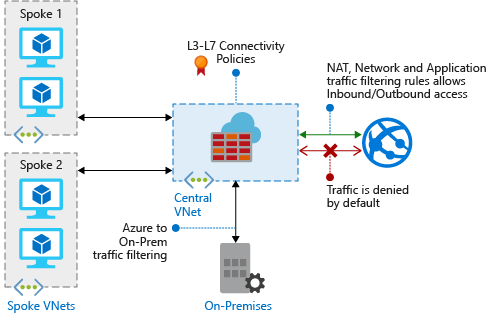
You can centrally create, enforce, and log application and network connectivity policies across subscriptions and virtual networks. Azure Firewall uses a static public IP address for your virtual network resources allowing outside firewalls to identify traffic originating from your virtual network. The service is fully integrated with Azure Monitor for logging and analytics.
What are Azure Firewall Features
The service boasts a suite of features aimed at providing comprehensive network protection:
Built-in High Availability: Azure Firewall eliminates the need for external load balancers through its inherently high availability architecture, ensuring that your firewall is always operational without any additional setup.
Unrestricted Cloud Scalability: It dynamically scales with your network traffic, meaning that your security measures scale with your needs without necessitating upfront peak traffic budgeting.
Application & Network Traffic Filtering Rules: Azure Firewall allows the creation of detailed allow or deny rules based on source and destination IP addresses, ports, and protocols, across multiple subscriptions and virtual networks. Its fully stateful nature ensures legitimate packets for various connections are correctly identified and logged.
FQDN Filtering & Tags: Outbound HTTP/S traffic can be limited to specified fully qualified domain names (FQDNs), including support for wildcards, without requiring SSL termination. Additionally, FQDN tags simplify the process of allowing traffic from well-known Azure services, like Windows Update, through the firewall.
SNAT & DNAT Support: Azure Firewall employs Source Network Address Translation (SNAT) for all outbound traffic, translating virtual network IP addresses to a static public IP. For inbound traffic, Destination Network Address Translation (DNAT) ensures that network traffic is correctly routed and filtered to private IP addresses within your virtual networks.
Azure Monitor Integration: All firewall events are integrated with Azure Monitor, offering robust logging and analytics capabilities, including the option to archive logs to a storage account, stream events to Event Hub, or send them to Log Analytics for detailed analysis.
Known Azure Firewall Issues & Mitigations
Despite its robustness, Azure Firewall has known challenges, such as conflicts with Azure Security Center’s Just-in-Time (JIT) access feature, limitations with hub and spoke models using global peering, and issues with network filtering rules for non-TCP/UDP protocols due to SNAT limitations with the Standard Load Balancer. Additionally, there are certain constraints around moving firewalls to different resource groups or subscriptions and limitations on port ranges in network and application rules. Many of these issues have workarounds, such as reconfiguring network architecture or awaiting future software updates for enhanced support.

